Showing posts with label justice. Show all posts

Thursday, August 21, 2025

The Garden of Accountability and Grace on First Harvest

The Garden of Accountability and Grace

We gather at the turning of the season—Lughnasadh, Lammas, the First Harvest marked the beginning of August. A festival of ripening, reaping, and reckoning. The days are still sunny. Boy howdy, the sun is still warming us! But the days are noticeably shortening. The fields are full, and the shadows are lengthening.

This is the beginning of the end of summer. And it's also a beginning of its own.

First Harvest invites us to pause. To honor what we have grown—what has grown in us. To ask: What did I sow? What am I harvesting from that? And perhaps more tenderly: What didn't grow? What seeds failed? What plantings began and then did not bear fruit? What needs to be composted?

We usually think of harvest as celebration time. But it's also accountability time.

Harvest and accountability say no to punishment, no to perfectionism, but yes to presence. 

They say yes to what is.

Accountability asks us to face the truth—face the truth of our impact, not just our intent. We check the field. Not the seed packet, not the planting plan, but the actual soil, the actual field, the actual fruit. What came up? What didn't? What failed to thrive?


Fresh picked tomatos on a bed of lettuce. Pixabay CC0

A Story

I want to share a story.

Several years ago, I was part of a community organization I believed in deeply. I showed up with good intentions, with energy, with training, with ideas. I thought I was helping. My vision was so sure. I had a plan.

But over time, I began to hear feedback—gentle at first, and then more direct—that my way of showing up was taking up too much space, was hurting certain individuals, was not working with the culture of that particular group. That I wasn't listening as well as I thought I was. I was trying to push a river that did not want to be pushed.

And I got defensive. I wanted to explain myself. I mean, I was right. But accountability isn't about defending our intentions—it's about listening to our impact.

I remembered a bus driver I knew. He would enforce traffic laws with his bus. He was right... but that was really dangerous. Someone could end up dead.

So I paused. I stepped back. I asked myself: What am I harvesting here? And the answer wasn't growth for the organization, it wasn't increased accountability for the board, it wasn't even improved relationships. In fact, I was poisoning the fields with my vision and approach.

I knew I needed to leave. I grieved, I grieved hard. And I was embarrassed. And I was angry. I mean, remember? I was right.

And I grew. I don't know if the organization improved its processes or became more accountable to its membership, but I was no longer flinging myself against a wall.

Turns out, being right isn't enough. I needed to change.

This experience taught me what Rev. Angel Kyodo Williams means when she writes: "Without inner change, there can be no outer change. Without collective change, no change matters."

Accountability is the inner change. It's the willingness to look at the garden honestly. To name what thrived—and what didn't.


Bus on Road, Columbus OH. Photo by Chris F. CC0

Where Grace Shows Up

And here's the thing: Accountability all on its own can feel heavy. It can feel exhausting, it can feel accusatory. It can feel like standing in the field and only noticing the withered crops, wondering where you went wrong.

So that's where grace needs to show up.

Grace isn't an escape hatch. It isn't a get-out-of-jail-free card. It's not letting ourselves off the hook. Grace is what makes staying accountable possible.

Grace is being the soft animal that is our body. Grace is being human. Grace is the peace of knowing what is and still loving yourself. Grace is compost. It takes what's decaying and makes that holy.

bell hooks reminds us: "Forgiveness is an act of love for the self and for others, and it opens up possibilities for grace."

Grace doesn't erase our accountability. It makes the transformation possible. With grace, you can take the withered stalks, the unsprouted seeds, the insect-eaten fruits, and you can plow them back into the soil and renew the garden's resilience.

Grace says: You are still worthy. You are still growing. You can try again.


Mustard Greens in Fall Garden. Photo by Eileen Kane, licensed as CC2.0

Holding Both

At first harvest, we hold both. In fact, here in Portugal, this time of first harvest is the time to plant for the next harvest. We get a do-over.

We grieve, and we celebrate. We mourn the crops that didn't make it. We tend to the ones that did. We name what we are proud of. We name what we regret.

We glean, we gather what's left at the margins—what might have been overlooked. We honor the imperfect abundance.

Remember that the garden is not just ours—it's shared. And so is the work of tending it. It's all of our garden.

Accountability and Grace in These Times

These questions of accountability and grace—they're not just for our personal gardens. They're for the public square too.

How do I stay accountable to myself, my loved ones, my neighbors—knowing that my neighbors include unhoused people, trans people, people of color, people whose very existence is under threat right now? Accountability here means checking my impact, not just my intent. It means asking: Am I showing up in ways that actually help, or am I just making myself feel better? Am I listening to the people most affected, or am I imposing my own vision of what help should look like?

And grace—how do I offer grace to folks who are lacking empathy or lacking comprehension of the harms being done in these times? Accountability is saying, "When you know better, you can do better." Grace is saying, "I will not condemn you for not knowing better." But grace doesn't mean being naive. It doesn't mean having no boundaries. I can believe someone is whole, holy, and worthy, and still choose not to talk with them. Grace can be protecting my energy for the work that matters. Grace can be saying "I see your humanity" without saying "and therefore I'll accept your harm."

How do we offer grace to ourselves so that we DO try again when we fail? Because we will fail. We'll say the wrong thing, miss the important thing, show up imperfectly. Grace says: You're still worthy. You're still growing. You can try again. And the world needs you to try again.


August Sunflowers. CC0 licensed photo by Mary Jane Duford from the WordPress Photo Directory.

An Invitation

So I invite you to reflect: What have you learned this year about accountability? Where are you being invited to extend grace—to yourself, to someone else? What does your harvest look like, really? What are you called to do with it?

How are you being called to tend the shared garden of our communities, our democracy, our world?

Blessing

We grieve the promises we could not keep. We grieve the seeds that didn't rise, the grace we withheld from others, from ourselves. We grieve what we hoarded and what we lost.

And still, the barley is there, bending golden in the field. Still the sun warms us. Still the earth says: Try again.

May you be honest about what grew. May you be gentle with what didn't. May your hands stay open—to give, to grieve, to gather. And may your heart learn the alchemy of grace.

Sunday, May 04, 2025

May the 4th Be With You: Rising Together Against Empire

May the 4th Be With You: Rising Together Against Empire

Every May 4th, fans across the galaxy celebrate Star Wars — but this isn't just about lightsabers and epic space battles. At its core, Star Wars is a story about resistance. It’s about ordinary beings choosing to rise up against a brutal Empire, refusing to let fear, apathy, or despair win. Today, let's remember the spiritual heart of the Rebellion — and what it can teach us in our own time.

Let us celebrate the message within Star Wars — a saga not only of battles and planets, but of people who commit to doing what’s right when the outcome is uncertain. These stories are filled with reminders that even in the bleakest moments, we are still called to the work: to resist empire, to protect what we love, and to hold fast to one another.

✨ “Rebellions are built on hope.” – Jyn Erso, Rogue One

But they are not, are they? They are built on relationship, commitment, love, perseverence. The film "Rogue One" was entirely about a group doing what needed to be done, knowing they were almost guaranteed not to survive. Rebellions are not just built on strategy or numbers. They’re built on people who show up, who choose integrity when it costs them something, who continue even when they can’t see how things will end. The Rebellion holds because people refuse to quit — not because they’re sure they’ll win, but because they know who they are.

🌀 “The Force will be with you, always.” – Obi-Wan Kenobi, (Original Series)

This isn’t about magical power. It’s about trust. About being connected to something deeper — call it Spirit, or Source, or just the sacredness of life. Even in exile, even in ruin, the Force is with those who align themselves with justice and compassion.

💥 “I am one with the Force and the Force is with me.” – Chirrut ÃŽmwe, Rogue One

Chirrut did not actually wield the force. He believed that all were connected through the force. A breath, a chant, a commitment. When the world feels too much, we return to this rhythm. We are not alone. Our actions matter. Even if we fall, the work continues — and we are part of something greater than ourselves.

🛡 “It’s not about fighting what we hate. It’s about saving what we love.” – Rose Tico, Last Jedi

When exhaustion and despair creep in, we remember: we aren’t just resisting. We’re protecting. We’re tending to what matters — the earth, each other, future generations. The Rebellion isn’t just opposition. It’s care, courage, and love-in-action.

🔥 "We have everything we need." – General Leia Organa, The Last Jedi

Empires rely on fear, silence, and division. But the people — when we remember our strength, when we organize, when we hold fast to our values — are more powerful than any Death Star.


General Leia Organa

So today, on May the 4th, may the Force be with you.

Not as a promise of victory, but as a companion in the long work of compassion, disruption, and repair. We are not called to be heroes — only to be faithful to the work. Whether you're a healer, a dreamer, a fighter, or a farmer: the path of resistance is yours to walk.

This is how we endure.
This is how we belong.
This is how we rise.

May the 4th be with you. And with us all.

Beloved, you are whole, holy, and worthy,

Rev. Amy

Tuesday, April 29, 2025

Fires of Love, Fields of Labor: May Day Meets Workers’ Day

May Day: Honoring All the Work That Sustains Us

May 1st is a day of paradox and power. It’s Beltane, a time of fertility, fire, and renewal in Pagan traditions — when the Earth’s abundance begins to blossom, and we honor life bursting forth in all its forms. It’s also International Workers’ Day, a day of protest, remembrance, and solidarity rooted in the labor movement and the fight for dignity and justice for all who work.

These two May Days — one ancient, one modern — share more than a calendar date. Both remind us that life requires tending. That something sacred happens whenever people rise up, plant seeds, or care for one another. And both call us to remember: not all labor wears a uniform or draws a paycheck.

Ripe Figs, CC0

The Work ThatGrows the World

The Earth Works. We Work.

Beltane is a celebration of Earth’s labor — the flowering, the fruiting, the unseen toil of root and mycelium. It’s also a reminder that human survival depends on the often invisible work of care: food grown, meals cooked, children held, elders supported, bodies and communities tended.

International Workers’ Day lifts up the labor struggles of wage earners — especially those who’ve been exploited, underpaid, or made invisible by systems that value profit over people. But the meaning of “worker” cannot stop at factory gates or office doors.

Judy Heumann and Barbara Ransom pose for a photograph at TASH's Outstanding Leadership in Disability Law Symposium and Awards Dinner on July 25, 2019. Photo by Bailey Hill CC4.0

The Work of Surviving

So many people — especially disabled, queer, racialized, and impoverished folks — do not survive because they are “productive.” They survive through grit, mutual aid, community, and the sacred labor of persistence.

There is holy work in getting out of bed when the world is heavy.

There is holy work in navigating systems that weren’t built for your body or brain.

There is holy work in staying alive, in dreaming of something better, in loving what the world tells you is unlovable.

Women’s Work, Love’s Work

Historically, “women’s work” — often unpaid, often unseen — has included birthing, feeding, caregiving, cleaning, mending, nursing, comforting, teaching. This labor is the backbone of every society, yet so rarely honored.

And what about the work of loving? Loving our people, our communities, the land, the sacred, ourselves? That’s not soft. That’s revolutionary. Love is a practice. A risk. A labor.

A boxing club on a snowy day in Lower Manhattan

Try It: Expand Your Definition of Work

  • Name a kind of work you do that you’ve never been paid for. Say it aloud. Claim it. It counts.
  • Honor someone in your life who works in unseen or undervalued ways — send a note, light a candle, share their story.
  • Join in collective action — not just protests, but community meals, mutual aid drives, or spaces of joy and solidarity. The work of changing the world is shared.

Sacred Renewal, Fierce Solidarity

Beltane reminds us that renewal is possible. That growth follows long winters. That life insists.

International Workers’ Day reminds us that no one is free until all are free. That change is built through collective effort. That every kind of laborer deserves respect and rest.

So today, may we:
  • Celebrate what is blossoming
  • Refuse what is dehumanizing
  • Honor all the work — waged and unwaged, visible and invisible — that sustains life
You are whole, holy, and worthy.
Your work — all of it — matters.

Rev. Amy


Monday, April 14, 2025

When the World is on Fire: Why Spiritual Care Still Matters

Not everyone has to be a fire fighter to put out a fire. Some of us have to be water carriers.

When authoritarianism rises, when rights are stripped away, when the fabric of society frays—what is the point of tending to small things? What is the point of spiritual care when fascism gains ground?

The answer is simple, but not easy: the work of spiritual care still matters. In fact, it matters more.

Naming the Tensions

In a moment like this, we’re pulled in many directions.

  • Panic: Drop everything. Scream. Mobilize.
  • Grief: Lie down and cry. Lose faith in what we do.
  • Numbness: Pretend it’s not happening. Keep busy. Keep scrolling.
  • Determination: Carry on with work and routines as if nothing has changed.

And for those of us whose work centers around care, spirit, healing, and justice, there’s an added tension:

How do I do this work now? Is it selfish to keep tending to my practice, to my livelihood, to my own healing while the world is burning?

Burning dumpster at George Floyd protests in Washington DC, Lafayette Square by Rosa Pineda CC4.0

Yes, Your Work Still Matters

I want to say this clearly: spiritual care is not a luxury. It is not optional. It is not secondary to “real” resistance.

Spiritual care is part of resistance.

The practices we offer—presence, reflection, discernment, connection, grief-holding, joy-tending—these are what keep people human in the face of dehumanization. These are what make the difference between despair and determination, between burnout and resilience.

If you’re a caregiver, a healer, a spiritual companion, your work is part of the resistance. You are offering people a lifeline. You are helping them find their ground when the world is shaking.

Personal Crisis in Public Crisis

And what if your personal life is also unraveling? What if you’re navigating divorce, illness, poverty, grief?

Well, of course that is happening. Life is still “life-ing.”. That’s not a disqualification. That’s part of the truth.

Your heartbreak does not make your care less valuable. It may, in fact, deepen it.

Your questions about what to keep, what to let go, and what to rebuild—those are holy questions.

There’s no shame in regrouping. There’s no shame in starting over. There is no shame in needing care and offering it. We are in this together, and none of us is immune to the ache of these times.

So How Do We Go On?

  • Gently. With ourselves. With one another. With the work.
  • Imperfectly. Trusting that “enough” is still sacred.
  • Creatively. Letting old models go if needed, experimenting with what still resonates.
  • With discernment. Listening for what’s real, what’s needed, what’s yours to hold.

Try This

  1. Set a timer for ten minutes.
  2. Ask yourself: What part of my work still feels alive?
  3. Write down whatever comes. Don’t judge.
  4. Then ask: What needs to rest? What’s worth tending now?

You’re not alone in this.

The work of care—spiritual, emotional, communal—is never easy, and even less so in times of crisis. But it is still ours to do. Not perfectly. Not endlessly. But with presence, with honesty, and with courage. The world may be on fire, and still, we keep lighting candles. Not to deny the dark, but to remember we are not forsaken. Our work remains. We remain. Let’s keep tending the sacred together.

Beloved, you are whole, holy, and worthy,

Rev. Amy

Thursday, April 10, 2025

The Sacred Fire of Anger

Making Friends with Anger

A reflection for spiritual companions and seekers alike

There is a kind of fire that burns clean.

Too often we are taught to fear anger. To suppress it, silence it, spiritualize it away. We are told that “good” people are calm, measured, forgiving, never furious. Especially those of us socialized to be caretakers—women, queer folks, BIPOC, disabled folks—we are often expected to bear injustice quietly, or at most with polite critique.

But righteous rage is sacred. It is holy energy. It says: this is not okay. It fuels resistance. It fuels change. And it can also fuel care.

Fiery outline of the word LOVE, CC0

When my mom was dying of cancer, I found myself filled with an anger that surprised me. Anger at the disease, at what it was stealing, at the helplessness of it all. But that fire lit something in me. It gave me the energy to speak brave, vulnerable words to her—words I might not have dared if I’d only stayed in grief or numbness. 

Anger gave me the energy to show up for an abused elder, advocating for his safety and doing what needed to be done to remove him from the dangerous situation. That anger didn’t turn violent. It created boundaries. It was fierce love.

Anger doesn’t have to mean harm. In fact, when we repress it, that’s when it turns inwards—into shame, illness, bitterness. But when expressed wisely—at the right time, in the right way—it can open doors to healing and justice.

Woman holding torch with blue background, CC0

Sometimes I curse to myself—mutter sharp words, swear under my breath, or speak with a kind of fire that helps move the energy through me and out. It’s not always pretty, but it’s honest. These words are often born of a need to stay grounded, to give form to my anger so it doesn’t fester unspoken. Anger, after all, is movement—it wants expression, wants release. In those moments, I don’t fear the heat of my words. I let them rise, trusting that even rage can be sacred when it flows rather than festers.

And sometimes I joke that I want to cast a curse. But not a curse meant to cause misfortune or harm. No, the curses I imagine are acts of transformation. A spell like: “May you be filled with compassion.” Or: “May you feel how your words land on someone’s spirit.” Or: “May the next person you try to insult surprise you with their dignity.” These are the kinds of spells I want to send into the world—fierce and clear, rooted in care. They arise from a place where anger meets love, where the commitment to change burns just as hot as the outrage itself.

As spiritual companions, we often sit with those whose anger is tangled up in grief, trauma, or injustice. Our role is not to calm them down. Our role is to hold space for their fire, and help them discern how to use it. Anger might be the very thing that empowers someone to set a boundary, or to leave a toxic system, or to speak truth after a lifetime of silence.

Welcoming fire in stone fireplace, CC0

In a world that is constantly offering reasons to feel powerless—racism, transphobia, climate crisis, war—it is anger that can move us from despair to action. It is anger that interrupts complacency. And it is anger, strangely, that sometimes helps us love better. Because we care that much. Not the kind of love that is about being nice, or even kind, but fierce love—the kind that tells the truth, that shows up, that protects the most vulnerable. The kind of love that makes change.

May we give ourselves, and those we walk with, permission to feel angry.

May we learn to channel that energy into courageous compassion.

And may we honor the sacred fire—not to destroy, but to illuminate the path toward justice and wholeness.

Beloved, you are whole, holy, and worthy,

Rev. Amy

Sunday, February 23, 2025

You Belong Here: Your Place in the Work of Justice

Finding Your Place in the Work of Justice

It’s easy to think activism comes in only two flavors: shouting in the streets or despairing at home. But the truth is, there’s a whole matrix of ways to be engaged - ways that honor both your capacity and the needs of the world.

PickPik, royalty free

Where do you fit? That depends. You need to ask yourself two questions:

1. Am I over-risking or over-functioning? Are you burning out, running on fumes, taking on more than is sustainable? Are you showing up in ways that exhaust you rather than energize you? Activism that neglects joy isn’t sustainable. Comfort the afflicted, including yourself.

2. Am I avoiding necessary conflict? Are you being “nice” when you need to be truthful? Are you leaning on spiritual bypassing, hoping love and light will make injustice disappear? Sometimes, transformation requires tension. If you have privilege – whiteness, cisness, maleness, class privilege – it may be time to take more risks. Afflict the comfortable – even if that’s you.

Credit: Rev. Kate Wilkerson

Compassion is Key

For those being directly targeted in this political climate: your safety comes first. Prioritizing your well-being isn’t a failure of activism, it’s often the most radical act you can take. Asking for help, leaning on community, and ensuring you have what you need to survive is sacred work. You are not required to be a martyr.

And if you are in a position to aid or shelter someone in need? Do so. The question is always: Who is my neighbor? The person in need is my neighbor. Maybe that means literally standing between them and the cameras (or the hecklers) at a rally. Maybe it means donating to Pink Haven, helping trans people relocate to safety. Maybe it means checking in on your friends, showing up with a meal, offering a ride. It always means directly asking, “How can I Help?”

What Can I Do?

Joanna Macy describes three dimensions of “The Great Turning” toward a life-sustaining society:

  • Holding actions: Directly interrupting harm: protests, advocacy, legal action.
  • Structural change: Creating alternatives: building new systems and ways of being.
  • Shift in consciousness: Changing how we see the world: spiritual work, education, cultural transformation.

No single one of these is enough. We need all three. You can read more about this framework at The Work That Reconnects.

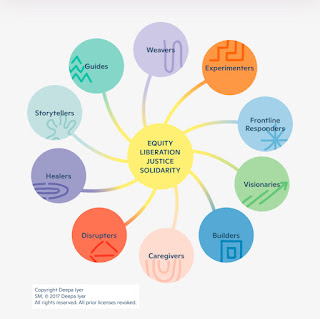
And within each, there are even more ways to engage. Deepa Iyer maps out ten roles people take in movements: builders, caregivers, disrupters, visionaries, and more. The work is vast, and you have a place in it.

Your Place in the Work of Justice

There’s no single “right” way to engage. But there is a right way for you, right now. And as you grow, your role may shift. What matters is that you pay attention: to yourself, to your community, to the world. Move toward the work that calls to you, and let it change you.

Justice isn’t a solo act. It’s a living, breathing movement, and we all have a part to play.

You are whole, holy, and worthy,

Rev. Amy

Tips:

  • Don’t reinvent. There are organizations that have been doing this work well, who can guide you. See for example, the list on “Human Rights Careers”, Side With Love, LWV.org, National Congress of American Indians (NCAI), Interfaith Movement for Human Integrity, Climate Justice Alliance (CJA), Building Movement Project.
  • Dance, sing, attend to beauty.
  • Notice the folks who are taking action – get inspired and share your inspiration. (Pink News, MeidasTouch)
  • Build relationships. 
  • Connect with the sacred, wherever and however you can.


Saturday, February 15, 2025

A Spiritual Practice for Resilience and Resistance

A Spiritual Practice for Resilience and Resistance

When oppression weighs on the body, mind, and spirit, we need practices that root us in our dignity, strengthen our resolve, and connect us to something greater than fear. The following spiritual practice is designed for those navigating injustice – whether you are directly targeted, supporting others, or working for change. This is a way to stay resourced, ethical, and present, even in times of struggle.

Preparing the Space

Find a quiet place where you feel safe. If that’s not possible, even a small symbolic gesture – a hand over your heart, a deep breath – can create the inner space you need. If you like, gather objects that remind you of strength: a stone, an image of an ancestor, a piece of cloth, or anything that carries meaning for you.

Grounding in the Body

Begin with noticing three deep breaths. Alternatively, place a hand on your heart or pulse point and notice your heartbeat. Gently attend to the wholeness of your body. Feel the weight of your feet pressing against the floor, this is the earth calling you home. Witness the presence of your own being. If it helps, hum softly or place a hand over bare skin or belly.

Say (aloud or silently):

I am here. I am real. I am worthy of love and dignity.

If you feel anxiety rising, imagine your blood, skin, and breath as a thread connecting you to all those who have walked this path before: ancestors, friends, strangers who share your struggle. You are not alone.

Naming Truth

Oppression thrives on silence and lies, convincing us that what we see and feel isn’t real. This part of the practice is about affirming what you know to be true.

Ask yourself:

  • What injustice weighs on my heart today?
  • What fear or anger is present in my body?
  • What truth do I need to say, even if only to myself?

Speak or write:

“I name this truth: __________. It matters. My feelings are real.”

If it helps, repeat a grounding phrase:

“One word of truth can outweigh the world.” (Aleksandr Solzhenitsyn)

Remembering Connection

Oppression isolates. Resistance, healing, and survival happen in community. Even when we feel alone, we are part of something larger.

Close your eyes (if comfortable) and call to mind:

  • A person, past or present, who gives you strength.
  • A community, near or far, who shares your struggle.
  • A greater presence: love, justice, the sacred, the ancestors.

Imagine their presence around you. If you wish, say:

I am part of something greater than fear. I am held in love and memory.

Releasing and Strengthening

Take a moment to release what does not serve you: fear, shame, exhaustion. Imagine setting it down beside you. It is not gone, you are not going to pretend it is not real, but you do not have to carry it alone.

Now, ask yourself:

  • What is one small action I can take today to honor my dignity?
  • What practice – prayer, movement, laughter, rest – can restore me?

Commit to one thing. It does not have to be big. Even a sip of water with intention can be an act of defiance against despair.

Closing

End with a phrase, prayer, or gesture that affirms your worth. You might say:

I am whole, holy, and worthy.

I belong to a lineage of resilience.

I am still here. And that is enough.


Move your awareness back to your heartbeat or breath. When you are ready, move forward into your day, knowing that resistance is not just in grand actions, but in each moment we choose dignity over despair.

Use this practice as often as you need. Share it with those who need it. Together, we continue.

Blessings of resilience,

Rev. Amy

Looking for support in creating rituals that foster community and resilience? Reach out to Rev Amy at http://AmyBeltaine.info
See similar rituals for Lament and communal resilience.