Showing posts with label burnout. Show all posts

Monday, April 14, 2025

When the World is on Fire: Why Spiritual Care Still Matters

Not everyone has to be a fire fighter to put out a fire. Some of us have to be water carriers.

When authoritarianism rises, when rights are stripped away, when the fabric of society frays—what is the point of tending to small things? What is the point of spiritual care when fascism gains ground?

The answer is simple, but not easy: the work of spiritual care still matters. In fact, it matters more.

Naming the Tensions

In a moment like this, we’re pulled in many directions.

  • Panic: Drop everything. Scream. Mobilize.
  • Grief: Lie down and cry. Lose faith in what we do.
  • Numbness: Pretend it’s not happening. Keep busy. Keep scrolling.
  • Determination: Carry on with work and routines as if nothing has changed.

And for those of us whose work centers around care, spirit, healing, and justice, there’s an added tension:

How do I do this work now? Is it selfish to keep tending to my practice, to my livelihood, to my own healing while the world is burning?

Burning dumpster at George Floyd protests in Washington DC, Lafayette Square by Rosa Pineda CC4.0

Yes, Your Work Still Matters

I want to say this clearly: spiritual care is not a luxury. It is not optional. It is not secondary to “real” resistance.

Spiritual care is part of resistance.

The practices we offer—presence, reflection, discernment, connection, grief-holding, joy-tending—these are what keep people human in the face of dehumanization. These are what make the difference between despair and determination, between burnout and resilience.

If you’re a caregiver, a healer, a spiritual companion, your work is part of the resistance. You are offering people a lifeline. You are helping them find their ground when the world is shaking.

Personal Crisis in Public Crisis

And what if your personal life is also unraveling? What if you’re navigating divorce, illness, poverty, grief?

Well, of course that is happening. Life is still “life-ing.”. That’s not a disqualification. That’s part of the truth.

Your heartbreak does not make your care less valuable. It may, in fact, deepen it.

Your questions about what to keep, what to let go, and what to rebuild—those are holy questions.

There’s no shame in regrouping. There’s no shame in starting over. There is no shame in needing care and offering it. We are in this together, and none of us is immune to the ache of these times.

So How Do We Go On?

  • Gently. With ourselves. With one another. With the work.
  • Imperfectly. Trusting that “enough” is still sacred.
  • Creatively. Letting old models go if needed, experimenting with what still resonates.
  • With discernment. Listening for what’s real, what’s needed, what’s yours to hold.

Try This

  1. Set a timer for ten minutes.
  2. Ask yourself: What part of my work still feels alive?
  3. Write down whatever comes. Don’t judge.
  4. Then ask: What needs to rest? What’s worth tending now?

You’re not alone in this.

The work of care—spiritual, emotional, communal—is never easy, and even less so in times of crisis. But it is still ours to do. Not perfectly. Not endlessly. But with presence, with honesty, and with courage. The world may be on fire, and still, we keep lighting candles. Not to deny the dark, but to remember we are not forsaken. Our work remains. We remain. Let’s keep tending the sacred together.

Beloved, you are whole, holy, and worthy,

Rev. Amy

Sunday, February 23, 2025

You Belong Here: Your Place in the Work of Justice

Finding Your Place in the Work of Justice

It’s easy to think activism comes in only two flavors: shouting in the streets or despairing at home. But the truth is, there’s a whole matrix of ways to be engaged - ways that honor both your capacity and the needs of the world.

PickPik, royalty free

Where do you fit? That depends. You need to ask yourself two questions:

1. Am I over-risking or over-functioning? Are you burning out, running on fumes, taking on more than is sustainable? Are you showing up in ways that exhaust you rather than energize you? Activism that neglects joy isn’t sustainable. Comfort the afflicted, including yourself.

2. Am I avoiding necessary conflict? Are you being “nice” when you need to be truthful? Are you leaning on spiritual bypassing, hoping love and light will make injustice disappear? Sometimes, transformation requires tension. If you have privilege – whiteness, cisness, maleness, class privilege – it may be time to take more risks. Afflict the comfortable – even if that’s you.

Credit: Rev. Kate Wilkerson

Compassion is Key

For those being directly targeted in this political climate: your safety comes first. Prioritizing your well-being isn’t a failure of activism, it’s often the most radical act you can take. Asking for help, leaning on community, and ensuring you have what you need to survive is sacred work. You are not required to be a martyr.

And if you are in a position to aid or shelter someone in need? Do so. The question is always: Who is my neighbor? The person in need is my neighbor. Maybe that means literally standing between them and the cameras (or the hecklers) at a rally. Maybe it means donating to Pink Haven, helping trans people relocate to safety. Maybe it means checking in on your friends, showing up with a meal, offering a ride. It always means directly asking, “How can I Help?”

What Can I Do?

Joanna Macy describes three dimensions of “The Great Turning” toward a life-sustaining society:

  • Holding actions: Directly interrupting harm: protests, advocacy, legal action.
  • Structural change: Creating alternatives: building new systems and ways of being.
  • Shift in consciousness: Changing how we see the world: spiritual work, education, cultural transformation.

No single one of these is enough. We need all three. You can read more about this framework at The Work That Reconnects.

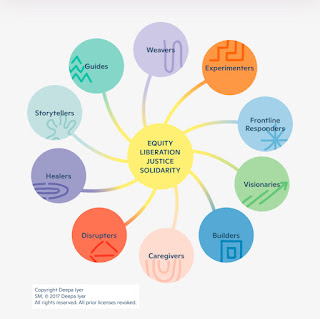
And within each, there are even more ways to engage. Deepa Iyer maps out ten roles people take in movements: builders, caregivers, disrupters, visionaries, and more. The work is vast, and you have a place in it.

Your Place in the Work of Justice

There’s no single “right” way to engage. But there is a right way for you, right now. And as you grow, your role may shift. What matters is that you pay attention: to yourself, to your community, to the world. Move toward the work that calls to you, and let it change you.

Justice isn’t a solo act. It’s a living, breathing movement, and we all have a part to play.

You are whole, holy, and worthy,

Rev. Amy

Tips:

  • Don’t reinvent. There are organizations that have been doing this work well, who can guide you. See for example, the list on “Human Rights Careers, Side With Love, LWV.orgNational Congress of American Indians (NCAI), Interfaith Movement for Human Integrity, Climate Justice Alliance (CJA), Building Movement Project.
  • Dance, sing, attend to beauty.
  • Notice the folks who are taking action – get inspired and share your inspiration. (Pink News, MeidasTouch)
  • Build relationships. 
  • Connect with the sacred, wherever and however you can.