Thursday, February 27, 2025

Companioning the Unexplainable: Spirituality, Mental Health, and Meaning

Companioning the Unexplainable, Spiritual Emergencies

Some seekers or congregants seek out spiritual care because they’ve had an experience they can’t explain. Perhaps they’ve heard a voice of guidance, encountered an angel, or received what they believe to be a message from the Divine. Others may have moments of profound insight, overwhelming love, or a deep sense of oneness with the universe. These experiences can bring wonder and transformation—but also confusion, doubt, or fear, especially in a culture that often dismisses the mystical as irrational.

As spiritual companions, or ministers, we are not here to diagnose or judge whether an experience is “real” in a clinical sense. We hold space for the seeker to explore its meaning. Take for example, the book, The Celestine Prophecy. It claims to be channeled wisdom, and while many question its origins, others find truth and inspiration in its pages. Instead of focusing on whether an experience meets external standards of credibility, we ask: How has this experience shaped you? What is it inviting you to?

This post offers a framework for companioning those who seek to understand experiences that challenge conventional ways of knowing.

Honoring the Guest’s Lived Experience

For some, mystical experiences – sometimes called “peak spiritual experiences” – bring peace, connection, or a renewed sense of purpose. For others, they are disorienting, challenging long-held beliefs or even sparking fear. A spiritual companion can support guests by:

  • Reminding them that they are not alone – Across history and cultures, people have had mystical encounters that shaped their lives in powerful ways.
  • Creating space for storytelling – Many have never shared their experience out of fear of being dismissed or judged. Simply speaking it aloud can bring clarity and relief. [See also this post on stories in spiritual direction.]
  • Honoring their spiritual context – Some may interpret an experience as a gift from God, a visitation from ancestors, a “download”, or a past-life memory. Others may struggle to find language for it. Companioning allows seekers to discern meaning in their own way.
  • Exploring transformation – A mystical experience often shifts a person’s worldview, relationships, or calling. Companions can help seekers integrate what has changed.

Gentle Exploration of the Experience

The role of a spiritual companion is to encourage the seeker to make meaning and develop their relationship with their sacred. Some guiding questions include:

  • What meaning does this experience hold for you?
  • How has it changed your sense of yourself and the world?
  • What emotions, insights, or questions has it brought up?
  • Where is, or was, the sacred in this experience?
Photo by Luke Palmer CC0

Discernment and Well-Being

Not every unusual experience is mystical. Some seekers may wrestle with whether what they’ve encountered is spiritual insight, psychological distress, or something else. This is especially true for those who have been pathologized for their experiences in the past.

As companions, we can:

  • Approach with curiosity, not assumption – Instead of defining the experience for the seeker, we invite them to explore what it means to them.
  • Consider the fruits of the experience – Has this experience led to greater love, peace, and wholeness? Or has it brought distress, fear, or harm? Traditional discernment practices—like Ignatian reflection or listening for alignment with one’s deepest values—can be helpful.
  • Be aware of mental health concerns – While many seekers have spiritually meaningful experiences that are outside the norm, some may also be navigating mental health challenges. If a seeker is in distress, struggling with daily functioning, or experiencing harm, we can gently encourage professional support. Holding space for spirituality and affirming mental health care are not in opposition; they can be deeply complementary.

None of this means ignoring real distress or danger. If someone is in crisis, we have an ethical responsibility to make sure they are safe and aware of available mental health resources. (More on that in an upcoming post on mandated reporting and mental health first aid.) But outside of those moments, our role is not to diminish or explain away their experiences—it’s to hold space for them to explore what those moments mean.

FreepikCC0

The Problem with Diagnosing—and Alternative Perspectives

In conventional mental health care, spiritual or mystical experiences are often viewed through a diagnostic lens. The DSM (Diagnostic and Statistical Manual of Mental Disorders) is the primary tool for classifying mental health conditions, but it has been widely critiqued for pathologizing normal variations in human experience and for failing to account for cultural and spiritual dimensions of mental well-being (source).

Instead of classifying all altered states as symptoms of illness, some frameworks recognize them as opportunities for transformation. The Spiritual Emergence Network supports those experiencing intense spiritual awakenings that might be misinterpreted as mental illness. The Crazywise Project explores how some Indigenous and wisdom traditions approach these moments as meaningful rather than pathological (source).

Spiritual companionship offers an alternative space: one where people can process their experiences without the assumption that they need to be “fixed.”

The Gift of Nonjudgmental Presence

Mental health professionals diagnose and treat conditions based on clinical models. Spiritual companions, on the other hand, are not here to judge or diagnose—we accompany, listen, and help seekers find meaning in their experiences. We also need to avoid romanticizing experiences: If it feels like a crisis or unwelcome experience, we don't "fix" their perception, we help them contain and make meaning from it.

In a world quick to dismiss, explain away, or diagnose, spiritual companionship offers a rare gift: a place where seekers can be heard without fear of ridicule or dismissal. It can be tempting to evaluate a seeker’s experience based on our own frameworks: Is this real? Is this healthy? What does this mean? But spiritual companionship isn’t about imposing our worldview—it’s about honoring the seeker’s path.

Kripalu.org

By approaching these moments with warmth, curiosity, and deep respect, we offer something the world rarely does—a space where all ways of knowing are welcome, and where the mysteries of life can be explored without fear of judgment.

The question is not whether an experience fits within a particular framework, but how it invites the seeker to live more fully into their truth.

As spiritual companions, we are called to honor mystery. We do not have to determine whether an experience is “real” to recognize its impact. We listen, we hold space, and we trust the seeker’s own deep wisdom to emerge.

You are whole, holy, and worthy.

— Rev. Amy

———————

Further Reading & Resources

  • The Varieties of Religious Experience by William James – A classic exploration of mystical and spiritual experiences.
  • Listening to the Soul by Jean Stairs – A guide to spiritual companioning.
  • The Spiritual Emergence Network – Resources for those navigating transformative spiritual experiences.
  • Mystical Hope by Cynthia Bourgeault – Reflections on encountering the sacred beyond the rational mind.
  • CrazyWise Project – Exploring alternative perspectives on spiritual awakenings (YouTube).
  • Companioning for Spiritual Emergencies: PDF
  • Patheos: When to Refer in Spiritual Direction: Article
  • Neo-Pagan Spirituality and Mental Health – Honors Thesis
  • Spirituality, Religion, and Mental Illness – Factsheet
  • Critique of the DSM – Discussion
  • Stanislav & Christina Grof – Spiritual Emergency: When Personal Transformation Becomes a Crisis Offers a foundational understanding of spiritual crisis from a transpersonal psychology lens. Emphasizes that mystical experiences can be healing if they are properly supported. https://digitalcommons.ciis.edu/ijts-transpersonalstudies/vol36/iss2/5/ 
  • Emma Bragdon – Resources for Spiritual Emergency (Blog) Overview of how to distinguish spiritual emergencies from psychiatric conditions https://imhu.org/spiritual-emergency/psychosis-or-spiritual-emergency/
  • Malidoma Somé – Of Water and the Spirit An example of how indigenous traditions frame spiritual emergency as initiation, not pathology. Great for contrast with Western clinical models.
  • Trauma Stewardship: An Everyday Guide to Caring for Self While Caring for Others by Laura van Dernoot Lipsky with Connie Burk.

Have you or someone you know had an experience that defied explanation? I invite you to share reflections in the comments.

————-

To find a Spiritual Companion, visit http://AmyBeltaine.info or https://shorturl.at/pr0ue or http://UUSDN.org 

Free student-led spiritual companioning starting March 2025, March 2026, https://abeltaine.blogspot.com/2025/01/embark-on-spiritual-journey-with-free.html

This Heart of Spiritual Direction series is ©2025 Amy Beltaine, all rights reserved. You may freely reprint any blog post, website, or print resource. Simply include the following attribution, and if you print online, make the link at the end live:

Article ©2025 Amy Beltaine, all rights reserved. Reprinted with permission. This article and hundreds of others, along with other free resources are available at http://www.AmyBeltaine.info


Monday, February 24, 2025

How to Choose a Spiritual Care Training Program

How to Choose a Spiritual Direction Training Program

If you’ve felt the call to spiritual direction, you’ve probably noticed that there are a lot of training programs out there. Some are rooted in specific traditions, some are multi-spiritual, some focus on psychological insight, others on contemplative practice. With so many choices, how do you discern which program is right for you?

Pathmarkers near Pigeonswick Cottage, photo by Peter O’Connor CC2.0

Here are some key questions to help guide your decision:

1. What’s the Program’s Theological or Spiritual Orientation?

Some programs are rooted in a specific tradition – Catholic, Protestant, Buddhist, etc. – and train you within that framework. Others take a broader approach:

  • Inter-spiritual programs operate on the belief that all spiritual paths lead to the same core truth. They often emphasize commonalities across traditions and may encourage an integrated, universal approach to spirituality.
  • Multi-spiritual programs honor the richness of many traditions while supporting each person in their own. Rather than blending paths into a single approach, they celebrate the distinct gifts of each and invite deep engagement with your own spiritual heritage while learning from others.

Consider what feels right for your journey—do you want a program that aligns with your faith, one that blends traditions, or one that acquaints you with multiple perspectives while grounding you in your own?

Original art created by Amy Beltaine

2. What Learning Style Works Best for You?

Programs vary in how they structure learning. Some people thrive in structured academic settings with papers and grades, while others prefer experiential learning through reflection, discussion, and guided practice.

Consider:

  • Do you prefer self-paced study or live interactive sessions?
  • Do you learn best through reading and writing, group discussion, or hands-on practice?
  • Do you want opportunities for one-on-one mentorship and supervision, or do you prefer more connection with peers?

The best program for you will match how you learn and grow best.

3. Is the Program In-Person, Online, or Hybrid?

The format of a program deeply affects accessibility:

  • In-person programs can offer rich community experiences, but they often require travel and lodging, which adds cost and time.
  • Hybrid programs balance face-to-face connection with online flexibility but may still require periodic travel for convocations or retreats.
  • Fully online programs make training accessible regardless of location, often with live video sessions and interactive forums.

Your choice will depend on your learning preferences, travel ability, and accessibility needs.

4. What Kind of Community Does the Program Foster?

Do you want a tight-knit cohort where relationships deepen over time, or do you prefer a more self-paced approach? Some programs prioritize community formation, while others allow for more independence.

It’s also important to ask: How does the program honor each unique person? A strong training program will:

  • Welcome diverse identities and experiences with genuine inclusion.
  • Adapt to accessibility needs, whether that’s offering captioning, flexible pacing, or different ways to engage.
  • Recognize different spiritual journeys without forcing a single path.
  • Incorporate consent culture.

5. What Content and Approach Does the Program Emphasize?

Every program has its own focus and teaching style. Some are deeply theological, drawing from scripture and doctrine. Others lean into psychological insight, contemplative practice, or social justice. Many blend multiple approaches.

Ask yourself:

  • Do I want a program that is prayer-centered, contemplative, intellectual, pastoral, or something else?
  • Does the program teach specific techniques (like active listening, Ignatian spirituality, dreamwork, or embodied practices)?
  • Will I get practical experience offering spiritual direction?
  • Is there room for self-directed learning or credit for learning outside the program?
  • Is there support for using the program purely for personal development? Does the program support integrating SD work into my existing Reiki/Massage/Therapy/Tatto/X practice? And is there support for folks who wish to launch a sustainable SD practice?

6. What’s the Financial Commitment?

Training programs vary widely in cost. Some require a significant financial investment, while others (like mine!) aim to be affordable and accessible. Keep in mind:

  • Tuition may or may not include required books, supervision, or retreat fees.
  • Some programs offer scholarships or sliding scale options.
  • If you need to travel for in-person components, factor in the cost of transportation, lodging, and meals.

7. Does the Program Include a Spiritual Companion, Supervision and Praxis?

A good spiritual direction program doesn’t just teach concepts, it provides real practice. Strong programs will require:

  • Supervision: A mentor who helps you reflect on your practice, offering insight and accountability.
  • A spiritual companion: Someone who journeys with you as you grow into this work.
  • Praxis: meetings with real seekers where you can experience being a spiritual companion within the supportive container of the program.

Without these elements, training can feel theoretical rather than transformational.

Final Thought: What’s the Heart of the Program?

At its core, spiritual direction is about deep, sacred attending to the Divine, to oneself, and to others. The best program for you is the one that helps you cultivate that presence and discernment in the way that resonates most deeply.

If you’re exploring your options, I’d love to connect! Cherry Hill's two-year spiritual direction training program starts again in March. It’s designed to be affordable, deeply relational, and rooted in contemplative listening. Feel free to reach out or check out the details https://abeltaine.blogspot.com/2025/01/cherry-hill-spiritual-direction.html!

What questions do you have as you discern your next steps?

You are whole, holy, and worthy,

Rev. Amy

——

Here's a list of other programs: 
 https://abeltaine.blogspot.com/2025/01/spiritual-direction-training-programs.html


This Heart of Sacred Tending series is ©2025 Amy Beltaine, all rights reserved. You may freely reprint any blog post, website, or print resource. Simply include the following attribution, and if you print online, make the link at the end live:

Article ©2025 Amy Beltaine, all rights reserved. Reprinted with permission. This article and hundreds of others, along with other free resources, are available at http://www.AmyBeltaine.info

Sunday, February 23, 2025

You Belong Here: Your Place in the Work of Justice

Finding Your Place in the Work of Justice

It’s easy to think activism comes in only two flavors: shouting in the streets or despairing at home. But the truth is, there’s a whole matrix of ways to be engaged - ways that honor both your capacity and the needs of the world.

PickPik, royalty free

Where do you fit? That depends. You need to ask yourself two questions:

1. Am I over-risking or over-functioning? Are you burning out, running on fumes, taking on more than is sustainable? Are you showing up in ways that exhaust you rather than energize you? Activism that neglects joy isn’t sustainable. Comfort the afflicted, including yourself.

2. Am I avoiding necessary conflict? Are you being “nice” when you need to be truthful? Are you leaning on spiritual bypassing, hoping love and light will make injustice disappear? Sometimes, transformation requires tension. If you have privilege – whiteness, cisness, maleness, class privilege – it may be time to take more risks. Afflict the comfortable – even if that’s you.

Credit: Rev. Kate Wilkerson

Compassion is Key

For those being directly targeted in this political climate: your safety comes first. Prioritizing your well-being isn’t a failure of activism, it’s often the most radical act you can take. Asking for help, leaning on community, and ensuring you have what you need to survive is sacred work. You are not required to be a martyr.

And if you are in a position to aid or shelter someone in need? Do so. The question is always: Who is my neighbor? The person in need is my neighbor. Maybe that means literally standing between them and the cameras (or the hecklers) at a rally. Maybe it means donating to Pink Haven, helping trans people relocate to safety. Maybe it means checking in on your friends, showing up with a meal, offering a ride. It always means directly asking, “How can I Help?”

What Can I Do?

Joanna Macy describes three dimensions of “The Great Turning” toward a life-sustaining society:

  • Holding actions: Directly interrupting harm: protests, advocacy, legal action.
  • Structural change: Creating alternatives: building new systems and ways of being.
  • Shift in consciousness: Changing how we see the world: spiritual work, education, cultural transformation.

No single one of these is enough. We need all three. You can read more about this framework at The Work That Reconnects.

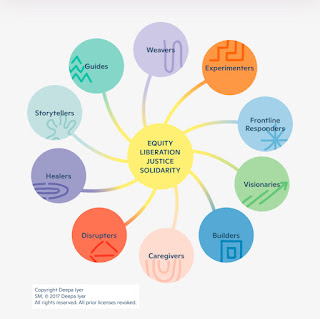
And within each, there are even more ways to engage. Deepa Iyer maps out ten roles people take in movements: builders, caregivers, disrupters, visionaries, and more. The work is vast, and you have a place in it.

Your Place in the Work of Justice

There’s no single “right” way to engage. But there is a right way for you, right now. And as you grow, your role may shift. What matters is that you pay attention: to yourself, to your community, to the world. Move toward the work that calls to you, and let it change you.

Justice isn’t a solo act. It’s a living, breathing movement, and we all have a part to play.

You are whole, holy, and worthy,

Rev. Amy

Tips:

  • Don’t reinvent. There are organizations that have been doing this work well, who can guide you. See for example, the list on “Human Rights Careers”, Side With Love, LWV.org, National Congress of American Indians (NCAI), Interfaith Movement for Human Integrity, Climate Justice Alliance (CJA), Building Movement Project.
  • Dance, sing, attend to beauty.
  • Notice the folks who are taking action – get inspired and share your inspiration. (Pink News, MeidasTouch)
  • Build relationships. 
  • Connect with the sacred, wherever and however you can.


Wednesday, February 19, 2025

Finding the Right Spiritual Companion: Safety, Trust, and Nourishment

Finding the Right Spiritual Companion: Who Do I Trust to Tend My Spirit

When we open ourselves to deep spiritual work, we are entrusting tender parts of our souls to another person. That’s no small thing. And in a perfect world, we could do so without hesitation, knowing we would be met with wisdom, care, and integrity. But we live in this world, where people can hold very different values, or be unskilled, or careless. If you have hesitations about beginning spiritual direction, they are not only understandable – they are wise.

That doesn’t mean you have to navigate the struggle and chaos alone. It means you deserve to be discerning.

Sunfish on the Potomac, MrTimMD CC2.0

So how do you find a companion who will truly nourish and support you? How do you ensure that you are safe while also receiving the care you long for? Here are some ways to honor both your wisdom and your spiritual hunger:

1. Take Your Time (and Meet More Than One Person)

Many seekers feel pressured to commit too quickly, especially if they’re eager for support. But a wise match is more important than a fast one. You should expect to meet with two to three potential companions before deciding who feels right. Spiritual direction is deeply personal, and finding the right fit takes time.

Notice how you feel when you meet each person. Do you feel seen and respected? Or do you feel subtly dismissed, talked over, or pushed? The body often knows before the mind does – pay attention.

2. Ask Questions (and Expect Thoughtful Answers)

You have the right to ask about their training, experience, and approach if it’s not already on their website. Ask how they handle difficult situations, ethical concerns, or differences in belief. A trustworthy companion will welcome these questions and answer with transparency. If someone gets defensive or vague, that’s useful information.

You can also check into the ethics of the training program they attended. Many spiritual direction programs have published ethical guidelines – do those align with what feels safe and right to you? A companion’s formation matters, not just in their skills but in the values they were taught to uphold.

3. Know That You Can Say No

Some seekers worry about disappointing a potential companion if they decide not to continue. But spiritual direction is a relationship, not an obligation. A good companion will respect your choice, even if you choose not to continue with them.

4. Ask About Consent (and Expect More Than Words)

A companion may have the best intentions, but do they actively practice consent culture? You can ask directly: How do you invite consent in spiritual direction? A thoughtful companion will have a clear answer – about topics of conversation, types of prayer, and even the pace of the work.

Consent is more than permission; it’s an ongoing practice. If you ever feel pressured –whether to share something personal, try a new exercise, or move faster than feels right – that’s a sign to pause and reassess. A healthy spiritual companion will respect your boundaries without hesitation.

5. Set Boundaries (and Watch How They Respond)

Healthy spiritual direction relationships have clear boundaries. If you ever feel uncomfortable with the level of personal disclosure, the setting, or the expectations, you can and should name that. If the companion reacts with grace and a willingness to adjust, that’s a good sign. If they react with frustration or dismissal, that’s a red flag.

6. Trust Can Grow, But It Shouldn’t Be Forced

You don’t need to trust someone immediately. Trust is built over time, through consistency and care. If you feel hesitant, that doesn’t necessarily mean this isn’t the right companion for you, it might just mean you need more time. A good companion will honor your pace.

7. A Good Companion Celebrates You

Spiritual companionship isn’t just about guidance–it’s about witnessing and honoring who you are. A good companion will recognize your wisdom, affirm your sacred worth, and celebrate both who you are and who you are becoming. If a companion makes you feel small, broken, or unworthy, they are not the right fit for you.

8. You Deserve to Be Nourished

Finally, let’s not lose sight of the heart of this work: you are seeking something real and meaningful. You deserve to be supported in that, not just safely, but with tenderness and wisdom. The right companion won’t just avoid harm–they will actively help you flourish.

You don’t have to navigate this journey alone. But you do get to choose who travels with you.


You are whole, holy, and worthy.

Rev. Amy

-----

To find a Spiritual Companion, visit http://AmyBeltaine.info or https://shorturl.at/pr0ue or http://UUSDN.org 

Free student-led spiritual companioning starting March 2026, March 2027, https://abeltaine.blogspot.com/2025/01/embark-on-spiritual-journey-with-free.html

This Heart of Spiritual Direction series is ©2025 Amy Beltaine, all rights reserved. You may freely reprint any blog post, website, or print resource. Simply include the following attribution, and if you print online, make the link at the end live:

Article ©2025 Amy Beltaine, all rights reserved. Reprinted with permission. This article and hundreds of others, along with other free resources are available at http://www.AmyBeltaine.info