Showing posts with label community care. Show all posts

Friday, October 24, 2025

Authoritarianism Thrives on Brittle Spirits: the Profitable Manufacture of Fear

The Profitable Manufacture of Fear: And the Critical Work of Spirit Tending

Why are we seeing a rise of fascism and authoritarianism across the world, especially in the United States? It's tempting to point to a single cause, but the truth is more complex. Economic inequality and dislocation, cultural backlash, disinformation, and climate instability all converge into one central outcome: fear.

Some fear is reasonable, especially for those most marginalized, who live under real and immediate threat. But much fear is deliberately engineered. Fear is profitable. It is used to divide communities, undermine solidarity, and keep people vulnerable to manipulation.

In this context, spiritual tending is not a luxury. It is critical. Because authoritarianism thrives on brittle spirits, while thriving communities are rooted, resilient, and alive.

The Roots of Rising Fascism

First, we name what is. Getting real is essential to re-membering our wholeness. Fascism is now, and has in the past, arisen in particular contexts.

Economic Dislocation and Inequality. Generations of wage stagnation and wealth concentration leave many people feeling powerless and disposable.

Social and Cultural Backlash. Expanding rights for women, queer and trans folks, Black and Brown communities, and migrants generates reactionary resistance from those invested in dominance.

Psychological and Tribal Dynamics. Fear easily flips into scapegoating; humans are wired to seek safety in "us vs. them" categories.

Environmental and Existential Stressors. Climate disruption and ecological collapse create widespread anxiety, uncertainty, and scarcity.

Disinformation and Media Ecosystems. News silos and manipulative platforms amplify outrage, fear, and conspiracy thinking.

Historical Patterns. Authoritarian movements often arise in periods of upheaval—what we are seeing is tragically familiar.

Together, these dynamics converge into a cycle of fear + inequality, weaponized by those who profit from division.

Water drop over parched land, Photo by Stockcake

The Engineered Fear Model

Engineered fear follows a predictable pattern:

Isolate people → from each other, from community trust, from nature, from their own sense of agency.

Flood them with crisis → so they feel powerless and dependent on "strong" leaders or controlling systems.

Break trust in the sacred → whether that's God, gods, the web of life, or inner wisdom. A person who knows they are whole and connected is much harder to control.

This model isn't abstract. It plays out in the profiteering we saw during COVID-19, in how media cycles keep us in crisis mode, and in political projects that thrive on keeping communities fragmented and afraid.

Discernment, Not Denial: The Role of Healthy Fear

Authentic spiritual practice doesn't bypass real dangers or systemic harm—it strengthens our ability to distinguish between manufactured panic and genuine threats that require action. When we're grounded in our values and connected to community, we can respond to climate crisis, political violence, or personal safety concerns from a place of clarity rather than reactivity.

This isn't spiritual bypassing. This is spiritual preparation for sustained, effective engagement with difficult realities. The goal isn't to eliminate fear. The goal is to cultivate the discernment that allows us to act from wisdom rather than being paralyzed by overwhelm or manipulated by those who profit from our terror.

Fear becomes healthy when it connects us to what we love and moves us toward protection and care: for ourselves, our communities, and the living world. It becomes toxic when it isolates us, makes us smaller, or hands our agency over to systems that don't serve life.


Pride Parade, Rawpixel CC0

A Counter-Practice of Spirit Tending

The work of spiritual direction and tending offers a radical, necessary counter-practice:

Reweaving Connection

Creating safe, intentional spaces where people explore meaning, belonging, and sacredness on their own terms. But this isn't just individual work. The work is about building networks of mutual care that are harder to divide and exploit. When people know they belong to something larger than themselves, they're less vulnerable to the false promises of authoritarian movements.

Restoring Agency

Helping seekers trust their own discernment, values, and choices instead of outsourcing them to fear-based systems. This includes strengthening our capacity to regulate our nervous systems under stress: work I explore more deeply in other posts about embodiment and trauma-informed spirituality. When we can stay present in our bodies even during difficulty, we make decisions from clarity rather than panic.

Cultivating Resilience

Equipping people with inner resources so that even in crisis, they respond from compassion and wisdom instead of reactivity. This resilience isn't built in isolation—it emerges from relationships. We need communities that practice together, share resources, and commit to each other's well-being across difference.

Lessons from History: When Spirit Tending Resisted Tyranny

Throughout history, spiritual communities rooted in authentic practice have provided crucial resistance to authoritarian movements.

During World War II, Quaker communities across Europe created underground networks that saved thousands of Jewish lives. Their commitment to "that of God in everyone" wasn't abstract theology—it translated into concrete action. They opened their homes, forged documents, and risked their lives because their spiritual practice had cultivated an unshakeable commitment to human dignity. Crucially, their decentralized structure made them harder for Nazi authorities to infiltrate or destroy.

Buddhist communities in Tibet and Burma have sustained resistance to occupation and military rule through practices that maintain inner freedom even under extreme oppression. Their emphasis on interconnection and compassion provided alternatives to the us-versus-them thinking that authoritarian systems depend on.

Indigenous land defenders across the Americas draw strength from spiritual connections to place that colonizers cannot fully comprehend or co-opt. At Standing Rock and countless other sites, ceremony and prayer become acts of resistance because they affirm relationships that capitalism seeks to sever.

Liberation theology movements in Latin America demonstrated how spiritual practice could challenge economic oppression and political violence while maintaining commitment to love and justice.

These examples share common threads: deep rootedness in practice, commitment to community beyond the self, and spiritual foundations that couldn't be shaken by external pressure.


Treeroots, CC0

The Trap of Spiritual Bubbles

But we must also acknowledge how spiritual communities can become complicit in the very dynamics they claim to resist. When spiritual practice becomes about comfort rather than transformation, or when communities become insular echo chambers, they lose their power to challenge systems of oppression.

Social media algorithms can turn spiritual hashtags into just another form of consumption, where profound practices get reduced to performance and spiritual bypassing. Similarly, spiritual communities that focus only on individual enlightenment while ignoring systemic harm can inadvertently serve as what Marx called "the opiate of the masses"—keeping people pacified rather than engaged.

The antidote is spiritual practice that consistently asks: How does this practice serve life? How does it connect me more deeply to the struggles and joys of my neighbors? How does it strengthen my capacity for sustained action on behalf of justice?

Find spiritual mentors, guides, and companions with ethical commitments you know and agree with. Do your individual work with people who practice consent and are willing to acknowledge what is real. 

The Choice Before Us

They win by keeping people spiritually brittle. We heal by becoming spiritually flexible, grounded, and unshakable.

Or in other words:

In an era when fear is deliberately manufactured to keep people small, disconnected, and reactive, my work tends the opposite soil. I accompany people as they deepen trust in their sacred wisdom, reweave bonds of community, and cultivate resilience rooted in what they hold most holy. Authoritarianism thrives on brittle spirits; my calling is to help grow spirits that bend but do not break.

Try It

Notice the places in your life where fear is pressing on you right now. Is it the news? Your community? Family tensions? Ecological uncertainty? Place your hand over your heart and whisper: Fear is not the whole of me.

Ask yourself: Where do I feel most alive, most rooted, most connected? What practice, place, or relationship brings you back to that sense of wholeness? Make time to nourish it this week.

Then ask: How might this groundedness serve not just my own well-being, but my capacity to show up for others? What would it look like to let my spiritual practice fuel sustained engagement rather than retreat from the world's pain?

Beloved, you are whole, holy, and worthy,
Rev. Amy
Companioning soul-weary change-makers becoming rooted, aligned, and alive again.

Sunday, February 23, 2025

You Belong Here: Your Place in the Work of Justice

Finding Your Place in the Work of Justice

It’s easy to think activism comes in only two flavors: shouting in the streets or despairing at home. But the truth is, there’s a whole matrix of ways to be engaged - ways that honor both your capacity and the needs of the world.

PickPik, royalty free

Where do you fit? That depends. You need to ask yourself two questions:

1. Am I over-risking or over-functioning? Are you burning out, running on fumes, taking on more than is sustainable? Are you showing up in ways that exhaust you rather than energize you? Activism that neglects joy isn’t sustainable. Comfort the afflicted, including yourself.

2. Am I avoiding necessary conflict? Are you being “nice” when you need to be truthful? Are you leaning on spiritual bypassing, hoping love and light will make injustice disappear? Sometimes, transformation requires tension. If you have privilege – whiteness, cisness, maleness, class privilege – it may be time to take more risks. Afflict the comfortable – even if that’s you.

Credit: Rev. Kate Wilkerson

Compassion is Key

For those being directly targeted in this political climate: your safety comes first. Prioritizing your well-being isn’t a failure of activism, it’s often the most radical act you can take. Asking for help, leaning on community, and ensuring you have what you need to survive is sacred work. You are not required to be a martyr.

And if you are in a position to aid or shelter someone in need? Do so. The question is always: Who is my neighbor? The person in need is my neighbor. Maybe that means literally standing between them and the cameras (or the hecklers) at a rally. Maybe it means donating to Pink Haven, helping trans people relocate to safety. Maybe it means checking in on your friends, showing up with a meal, offering a ride. It always means directly asking, “How can I Help?”

What Can I Do?

Joanna Macy describes three dimensions of “The Great Turning” toward a life-sustaining society:

  • Holding actions: Directly interrupting harm: protests, advocacy, legal action.
  • Structural change: Creating alternatives: building new systems and ways of being.
  • Shift in consciousness: Changing how we see the world: spiritual work, education, cultural transformation.

No single one of these is enough. We need all three. You can read more about this framework at The Work That Reconnects.

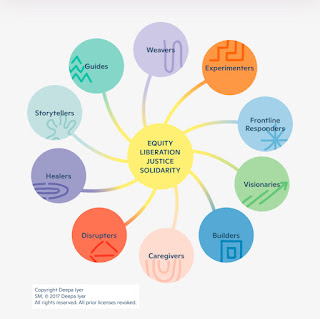
And within each, there are even more ways to engage. Deepa Iyer maps out ten roles people take in movements: builders, caregivers, disrupters, visionaries, and more. The work is vast, and you have a place in it.

Your Place in the Work of Justice

There’s no single “right” way to engage. But there is a right way for you, right now. And as you grow, your role may shift. What matters is that you pay attention: to yourself, to your community, to the world. Move toward the work that calls to you, and let it change you.

Justice isn’t a solo act. It’s a living, breathing movement, and we all have a part to play.

You are whole, holy, and worthy,

Rev. Amy

Tips:

  • Don’t reinvent. There are organizations that have been doing this work well, who can guide you. See for example, the list on “Human Rights Careers, Side With Love, LWV.orgNational Congress of American Indians (NCAI), Interfaith Movement for Human Integrity, Climate Justice Alliance (CJA), Building Movement Project.
  • Dance, sing, attend to beauty.
  • Notice the folks who are taking action – get inspired and share your inspiration. (Pink News, MeidasTouch)
  • Build relationships. 
  • Connect with the sacred, wherever and however you can.


Sunday, January 12, 2025

January with Janus: Facing Back to Face Forward

Facing This Moment

We begin 2026 carrying a particular weight. Many of us are watching systems we counted on become less trustworthy, witnessing the rise of forces that threaten the vulnerable, feeling the ground shift beneath us. This is real. And it matters how we meet it.

Looking back and facing forward, the practice of Janus, becomes especially important when the path ahead feels uncertain or threatening. We look back to remember our strength, our resilience, what has sustained us before. We face forward not with naive optimism, but with love and commitment to relationship, to community, to the work that must be done.

January with Janus: Facing Back to Face Forward

The start of a new year often brings a wave of resolutions: write a book, cook and eat at home from scratch, learn a new language. While these goals can be admirable, the pressure to achieve them perfectly often leads to disappointment and self-criticism—and right now, we need our energy for other things.

This year, as we enter a time that demands sustained commitment and collective care, consider shifting your focus from rigid resolutions to intentions that strengthen both your spirit and your connections to others.

The Wisdom of Janus

January derives its name from the Roman god Janus, the god of beginnings and endings, doorways, and transitions. Depicted with two faces, one looking back and the other forward, Janus embodies the cyclical nature of time and the importance of reflecting on the past to inform the future. 


"Janus"- watercolour by Tony Grist CC1.0
By looking back at the past year, we gain invaluable insights.

  • What were your greatest triumphs?
  • What challenges did you face and what did you learn from them?
  • What strengths did you discover within yourself?

These reflections provide valuable guidance as we set our intentions for the year ahead, but we don't live in the past. We can learn from it, but not dwell on (and in) it.

Beyond Resolutions: Choosing a Word of the Year

Facing forward, we can imagine how the coming year might look. Again, we don't live in the future, we dwell in the present. Making resolutions can bring the focus too much into the specifics of (let's be real here) an  UNKOWN future. Instead of focusing on specific outcomes, I invite you to choose a word of the year. This word should embody the essence of what you hope to cultivate within yourself throughout the year. For example, your word might be "joy," "growth," "peace," or "creativity."

Whatever word or intention you choose, remember: we don't build resilience alone. Your spiritual practice isn't separate from your relationships, your community, or the work that must be done in the world. Individual wellness matters because you matter, as a beloved member of community, as someone whose presence and participation are needed. We remain faithful to the work ahead, not through grinding ourselves down, but through practices that sustain us for the long haul.

A year might be too much to wrap your mind around. Perhaps that word is good, but not enough. In that case, consider imagining the future by season.

Setting Intentions Through the Seasons

Don't limit yourself to setting intentions just once a year. The work of sustaining ourselves and each other requires regular renewal. Explore the cultural and natural rhythms around you to discover smaller seasonal opportunities for reflection, rest, and reconnection to what matters most.

For the Northern Hemisphere, the Solstices, Equinoxes, and days midway between them can be a way to mark seasons. For folks closer to the equator these seasonal demarcations may not fit. Notice what is real for where you physically dwell.

Here's one way to approach seasons:

  • End of January (called Imbolc in some Pagan traditions) (February 2): A time of hope and renewal, celebrating the return of light. What seeds do you want to plant within yourself?
  • Spring Equinox (March 20/21): A time for balance and new beginnings. How can you bring more balance into your life? 
  • End of April (Called Beltane by some Pagan traditions) (May 1): A time of passion, creativity, and abundance. How can you cultivate more joy and lightness in your life?
  • Summer Solstice (June 20/21): A time of peak energy and abundance. How can you make the most of this vibrant time of year?
  • End of July (Called Lughnasadh by some Pagan traditions) (August 1): A time of harvest and celebration. What have you cultivated this year? What are you ready to let go of?
  • Autumn Equinox (September 22/23): A time of balance and preparation for the winter. How can you prepare for the coming months?
  • End of October (Called Samhain by some Pagan traditions) (October 31): A time of reflection, honoring ancestors, and letting go of what no longer serves you.
  • Winter Solstice (December 21/22): A time for rest, reflection, and inward turning. How can you nourish your inner world during this time of quietude?

Lunar Cycles

You may want to approach your experience of seasons by moon cycles. Many cultures pay close attention to the moon and many name each 28-day moon cycle, such as a "Wolf Moon" or "Strawberry Moon" or "Harvest Moon." You'll notice that these moon names refer to what is happening naturally during that moon-month. Perhaps you will want to name the moon-months for your area yourself, or do some research about the cultures that have flourished in your area, instead of borrowing from another culture? 

You can also align your intention setting with the phases of the moon. The new moon is a time for new beginnings, while the full moon is a time for release and culmination. 

Remember to source information about these seasonal transitions ethically, respecting the cultural significance of these observances.

Phases of the Moon (Pexels)

Instead of setting strict goals, consider using this time to face back, and face forward:
  • Reflect: Spend time reflecting on the past year. What were your biggest accomplishments? What challenges did you face? What lessons did you learn?
  • Acknowledge: Acknowledge your successes and celebrate your achievements, no matter how small.
  • Identify Themes: Instead of focusing on specific outcomes, identify overarching themes for the year. For example, instead of "lose 10 pounds," your intention might be to "cultivate a healthier relationship with my body" or "prioritize self-care."
  • Set Guiding Principles: Establish a few guiding principles to support your intentions. These could be:
    • Mindfulness: Cultivate greater awareness of your thoughts, feelings, and actions, both for your own wellbeing and so you can show up more fully for others.
    • Compassion: Treat yourself and others with kindness and understanding, remembering that we are all doing our best in difficult times.
    • Relationship: Prioritize connection and community. Your love is stronger than the dark, and we need each other.
    • Commitment: Remain faithful to the work that must be done, pacing yourself for the long road ahead.

Intention Setting Exercises:

Consider taking advantage of one of the many tools available to support this process. This reflection time in January is worth investing time and energy into.

  • Vision Board: Create a vision board to visually represent your intentions. Gather images, quotes, and symbols that resonate with you and reflect your desired themes for the year.
  • Journaling: Dedicate time each day to journaling about your intentions. Reflect on your progress, celebrate your successes, and adjust your approach as needed.
  • Mindful Meditation: Use meditation to connect with your inner wisdom and clarify your intentions.

For Deeper Exploration:

If you're looking for a more structured approach to intention setting, I recommend exploring the "Year Compass" workbook by Rebecca Campbell. This workbook provides a comprehensive framework for reflecting on the past year, identifying your core desires, and setting meaningful intentions for the year ahead.

By shifting your focus from rigid resolutions to flexible intentions and honoring the wisdom of Janus by looking both back and forward, you can approach the new year with openness, curiosity, and self-compassion. Remember that life is a journey, not a race—and you don't walk it alone. Celebrate your progress, tend to your connections, and trust that your love and commitment are enough for whatever comes. We remain faithful to the work that must be done, together.Working with a spiritual companion can help you deepen your reflection, gain new perspectives, and develop a personalized approach to intention setting.

  • If you are thinking of professional changes for the new year... consider the 2-year Spiritual Direction Certification program through Cherry Hill Seminary. There are still a few openings for our March 2026 cohort. This program trains spiritual companions for earth-based, Pagan, UU and multi-religious communities.
    If you've been considering a career transition into spiritual care, or want to add spiritual companioning to your existing ministry or helping profession, I'm holding discovery calls through January.
    The program is trauma-aware, justice-oriented, consent-based, and designed for working adults. 11 spots remaining, applications close February 15.
    Schedule a conversation: https://SpiritualTendingWithAmy.as.me/SpiDirInquiry
    Program details: https://abeltaine.blogspot.com/2025/01/cherry-hill-spiritual-direction.html
Beloved, you are whole, holy, and worthy,
Rev. Amy Beltaine