Saturday, August 11, 2018

What Type of "Witch" are You?

What Type of Witch are You?

Moon witch? Forest Witch? Bone Witch? Which witch are you? I was thinking about the types of magic, the types of lore, and the types of devotion earth-honoring and deities-relating folks engage in. I think of them as moon, forest, and bone domains. Inhabited by Moon, Forest, and Bone witches. Then I realized that I’d developed this idea before… for a game!

Moon, Forest, or Bone Witch? Which are you?
The latest D&D players handbook includes the “Warlock” class (a class is a sort of profession for your player). Anyone who has been in Paganism or earth-honoring spirituality probably knows that the word warlock means oathbreaker and we usually use ‘witch’ instead. (Yes, there are male witches.) The D&D warlock also is described as using “pact magic” which I imagine is reminiscent of the “pact with the devil” ideas made up by the medieval witch hunters.

So I created an alternative D&D class called Witch. As I mapped out the skills the witch would have I realized that I could easily conceive of three types of witches. Astral, Green, and Blood.

Astral Witches

"Astral Witch"
Don Crosby (Merlin)
by Artist Douglas Baulch CC 3.0
Astral witches are tuned into the planetary movements, the cycles of the seasons and the rotation of the earth. They derive their game powers from sunrises and sunsets, moon phases and astronomical events. They might be tarot card readers, astrologers, temple priest(esse)s or open ritual leaders. Moon witches, Sun witches, or Star witches are tuned into time and able to navigate by the stars. Astral witches are sometimes called wizards or sages and are wise about the timeless aspects of living - ethics, meaning, the rise and fall of civilizations. You find astral witches in urban contexts.

Green Witches

George Casely uses a hazel twig to find water
 by Ministry of Information Photo Division Photographer,
 IWM Non-Commercial License
Green witches derive their game powers from plants and the earth. They have a relationship (similar to druids in the game) to the land where they live and move. Like hedge witches of old, they can be healers, students of weather and growing things, and good cooks. Villagers seek out earth or land witches for help with gardens, children and love. You’ll find green witches affiliated with rural communities.

Blood Witches

Last Tuvan shaman.
Taken 1 week before her death.
by David Baxendale. CC BY-ND 2.0 
Blood witches derive their game powers from their own (or others) lives, bodies, bones and blood. They, like ancient shamans, interact with the ancestors of a person and the spirits of animals. Like tribal priests throughout the world, they are wise about death, about the inner world, and are advisers to clans and tribes. Blood and bone witches, or shamans, might be birth midwives and death midwives and facilitate small community ritual. Blood witches affiliate with peoples, tribes, and families.

Finding Your Type

Did you recognize any witches in your own life in these descriptions? Unlike D&D, in real life we can experience the wisdom of any of these three domains. We can embrace the spirit of Astral witches and work the magic of prophecy, warning people of the ethical errors of empire. As midwives, village healers, and caretakers of the community we can work the magic of herbal healing, whether it be through a cup of white willow bark tea for a headache or a cup of tea and conversation for a heartache. Like shamans we can work the magic of soul retrieval, reminding the community of their best selves, calling folks in, and singing the songs that remind us of our ancestors’ gifts. 

All of us can do community ritual honoring the changing of the seasons, celebrating birth and mourning a death together and we can do private candle magic ceremonies to mark our own life milestones, aspirations, bondings, and bindings.

Image composite. Free from Pixabay
My spiritual type has shifted over the years. I teach a class on spiritual types that takes into account your Enneagram type, MBTI and other factors. I used to exclusively identify with the green witch These days I’m resonating with the astral and blood witches as well. It might be age related, life phase related: moving from the immediate and practical, to the concerns of the public sphere, and finally, to the concerns of legacy and heritage. It might be that someone is authentically called to one type. Certainly I’ve seen young blood witches and old green witches. Or it can be something someone dances through all your life.

You might relate the astral witches to the priests and prophets, the green witches to the cunning men and cunning women, and the blood witches to the shamanic practitioners.
Was this enough to get you curious about which witch is alive in your soul right now?
--------------
Reverend Amy helps givers who are feeling disconnected or depleted to uncover and use their spiritual superpowers so you can conspire with divine love and build the world you dream of in flow and abundance. Learn more at http://amybeltaine.info, Book Here.

Monday, August 06, 2018

With Great Magic Comes Great Responsibility

Magical

Have you ever been so amazed, and overwhelmed (in a good way) that you said “It was magical, I got shivers!”? Looking back, each moment I said that, it was a moment of change in my consciousness, and change in my life. A moment of consequence!

In the stories and myths of our culture magic, or super-powers, are usually accompanied by a consequence. The Avengers are blamed for what goes wrong and treated with suspicion. The X-Men are persecuted. In a video game, using a power draws down your “mana” or life-force.


The magical sword Excalibur, that made Arthur king when he pulled it from the stone had power that came with terrible consequences. Harry Potter’s magical powers came with ever increasing responsibility. In the Movie, Frozen, Queen Elsa struggles to accept her powers, and it is not until she accepts both her power AND the responsibilities that come with them, that they become a gift instead of a burden. As Stan Lee, the creator of Spiderman, said “with great power, must also come, great responsibility.”

Responsibility


Composite from Disney film "Frozen"
The responsibility has to do with being in community. In the movie Frozen, Elsa’s powers were destructive when she was trying to suppress them: she made her entire kingdom sink into an eternal winter! Then, after she ran away she let go of the constraints she put on herself and ‘let it go”, but she cut herself off from her community. She needed love to invite her back into the community. When the community welcomed her, she accepted her responsibility and could use her powers in service to love and justice.

We are responsible for the things that we do. Running away does not fix that. But suppressing your own awesomeness also doesn't fix anything. You have a superpower, you probably have a couple. You are full of magic, I don't know what your magic is, but I bet your friends do... We each need our community, and they need our whole selves.

Folk Religions


Pagan stories and traditions describe the power that comes from the earth as magic, indigenous traditions describe the power that arises from a tribe and ancestors as magic. As we learn from myth and tradition we all have access to some of that magic power.

In UU congregations we usually don’t talk about spiritual matters in terms of power. But in the Pagan and earth-relating worlds we talk about spiritual power. The Aborigine of Australia, and the Shinto teachings speak of the dangers and responsibility of working with the power of spirit. Sufi, especially Dervish, spirituality speaks to the overwhelming and transformative experience of feeling the divine flow through and within us. Psychologists tell of the great power that spiritual awareness yields.

Creating Change


artists interpretation of creation and the milky way
There are many definitions of the word magic. One definition I like because it is compatible with what anthropologists learn from cultures that practice magic: Magic is creating change by connecting with the energies of nature and community. Some people go to the wilderness to recharge. Some go to the ocean to heal. We all need to mourn in community and celebrate marriages and milestones with community. When we look into a clear night sky and experience the vastness of space… we feel something… it's magic.

Around the world and throughout human history Indigenous traditions have tapped into this great spiritual power.

Candle Magic

Folk Religions have been powerful spiritual forces for a very long time. And Wicca, though it is not a true folk religion, has demonstrated striking strength. When something has been so important to human community for so long, so transformative, there must be jewels of wisdom within - Jewels we can learn from!

For instance, I think folk religions’ ability to talk about power, the connection to nature, and the ability to create ecstatic group ritual are fabulous jewels we grow from, individually, and collectively.

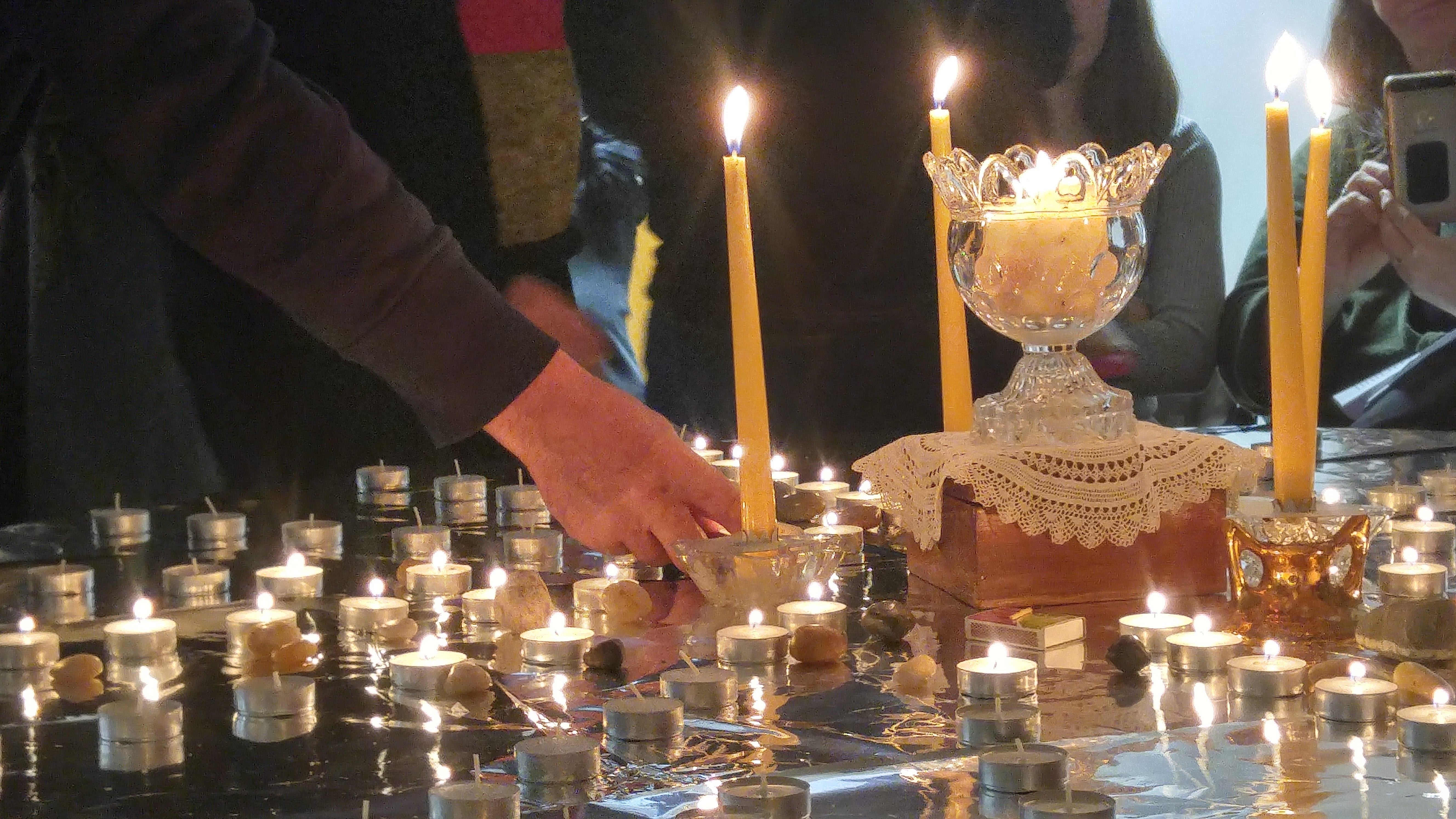
One practice that helps spiritual practitioners to grow and transform is candle magic. We light a candle to remember a person in Joys and Sorrows or to represent the family blessings at a wedding. We are practicing candle magic here today because we used the chalice lighting to help us focus on being here together.

Another spiritual practice is to dedicate yourself to the study of a divine aspect, like a god or goddess or mythical character. I spent a year meditating on the myth of Inanna’s pilgrimage to the underworld. I chose the Babylonian goddess Inanna as a way to recover from a very bad, horrible, no good year, when I experienced a lot of loss. The poetry, myths and rituals of Inanna losing everything and then returning (with a little help from her friends) helped me make sense of these losses and to rebuild my life and my power.


Magic has Consequences


Let’s go back to that word Magic. The definition of Magik, among Pagans is usually: “The art of changing consciousness at will.”

One of the consequences of doing the work of magic is that it can change reality like it did for me. If Magik is the art of transforming consciousness at will, what does consciousness create? Well, Schoedinger says that consciousness creates reality. So Schroedinger’s Cat would say that Magik has consequences in reality!

I want to be be very clear here. Ritual, prayer, candle magic, and all the rest is not putting in a request to the divine piggy bank for a specific pay-out. When I pray for world peace I’m not expecting Big Daddy in the Sky to go “POOF, OK, you got it.” When people paint themselves blue because that is their team’s colors, they are changing themselves, not actually making their sports team win. The only people who can do THAT magic trick are the players on the teams. 

I’m asking, like Susan B. Anthony did, to pray with my feet, my hands, my voice, my life. I’m asking to change ME so that I can change the world. I'm asking, now that you know you can do magic, how will YOU change the world?

-------------------------
Reverend Amy helps Givers and Justice-Seekers to uncover and use their spiritual superpowers through individual mentoring, speaking, retreats, workshops and rites of passage. Learn more at http://AmyBeltaine.info, or Book Here.

Saturday, July 28, 2018

UU or Pagan?

It's been a month of blog posts about how UU and Pagan can and do fit together. Here's my little bit.

Yesterday I took a couple of online tests. One quiz rated me theologically 100% Neo-pagan. Another quiz directed me to join a UU congregation. Yep. Exactly. UU and Pagan!


The Search

I spent over 20 years attempting to find or create consistent community, institutional consistency, strength, scientific and academic integrity, serious minded respect, respect for diversity and reliable structure among Pagan groups. Finding a religious home that included many of those things AND welcomed my Pagan spiritual path was sweet. I had been Gardnerian, Wiccan, Reclaiming, eclectic, Dianic... Nothing fit. UU did. That was my personal journey.


Solstice at Ithaca UU Fellowship
IthaCUUPS

On a broader level... The Pagans of IthaCuups at my congregation in Ithaca NY were a major force in creating Pagan Pride Day. UU was the ecumenical force among the often fundamentalist subgroups of Pagans in Ithaca at the time. And the CUUPS group grew the congregation, in size and in spiritual maturity. It took some work, by the pantheists, pan-entheists, Christians, and Pagans, to help the congregation become more comfortable with spiritual topics and expressions in Ithaca. That was good work.

The Jewish congregation that met at our UU congregation's building was welcome and appreciated. If a Pagan congregation/coven/grove/blot/fill-in-the-blank had wanted to enter into the same sort of partnership I like to think they would have been welcomed. UU congregations are equipped with our principles and purposes to enter into inter-religious partnerships like that.


One person's dating of religions. Do not read as progression.
Can you pick out which are
Earth-honoring/Deities-relating/Indigenous/Pagan?
Can you name some that are missing?
CUUPS

CUUPS is for those who are UUs who feel their theology would be called Pagan or Earth-honoring/Deities-relating, or vice versa. At the annual General Assembly of UUs the Earth-honoring UUs often share booth space with the Jewish UUs, Mystic UUs, Christian UUs, Buddhist UUs..., etc. We have friendly connections with Ministry for the Earth (which emerged in many ways from CUUPS) and the UU Women and Religion group (that was closely identified with CUUPS through the 70's.)

In congregations, many Buddhist UU groups host Buddhist gatherings at their home congregations, or even Sufi-appreciating UUs invite folks to lead Dances of Universal Peace at their congregations, just as Pagan UUs host gatherings where all Pagans are welcome.


I realize that not all congregations are fully on board with all the theologies that fit under the UU roof. Educating and developing mutually respectful relationships across faith differences is a learning edge. This is perhaps one of the greatest gifts to the world that Unitarian Universalism has to offer: Our striving, (and failing, and striving again) to move forward with an inclusive sense of Inherent worth and respect for the interconnections of life. Let us hope that congregations continue to learn and grow and that our neighbors continue to feel welcome and neighborly.


Tilikum Crossing "people's bridge"
 downtown Portland (Chinook word for friend)

Portland, Oregon


Then I moved to Portland, Oregon. I was thrilled to find most West Coast congregations embrace Earth-honoring and Pagan spirituality. I was confused by the antipathy of Pagans toward congregations of all kinds, including UU. Old wounds run deep. It is healing for indigenous and Pagan folks to experience Unitarian Universalism. No, we don't burn witches, we ask them to help with the kids and on the worship team and on the grounds team.

The benefits to and from UUs and Pagans run both ways. Earth-honoring folks in UU congregations can help wean their congregations from such fierce adherence to the trappings of Christianity in the worship style. Future UU Pagans would love to be a part of a congregation that offered worship/ritual and study/growth. I celebrate our Christian heritage. Christian UUs find that Pagan UUs are in alignment with them on some important things. Humanist UUs discover the same thing!

Coexist

At about 12% of the population those of us
in the "other" category need each other to survive

UU's aspire to tolerance, ecumenism, diversity, and respect. The world needs this desperately. UUs actively practice (and fail) and practice these things. Pagan traditions with strong belief structures or hierarchies or "ways of doing ritual" need this UU superpower too. It's a good thing when we can spread the saving practices of respect for the inherent worth of all people to other faith traditions.

Here's this beautiful thing I've noticed happening. Now that I am deeply in this UU context, I have been expanding my understanding of what Earth-honoring paths there might be. I'm exploring which ones connect to my heart most strongly. Explorations of my own indigenous heritage(s) is exciting and full of joy. The cool thing is that the commitment to racial justice work (that came to me through my family and my congregation) has contributed to this renewal of my spiritual seeking.

I think I've found a really great spiritual home. Unitarian Universalism fits this earth-honoring UU quite well!

N.B. IthaCUUPS folded some time around 2011. Good news though! The congregation still exists. Ithaca UUF is open to the next Earth-honoring or Pagan UUs who want to be a part of the community!
-----------
Rev. Amy travels West of the Rockies providing spiritual mentoring to helpers and justice seekers who are depleted or disconnected through preaching, worship leading, one-on-one meetings and workshops. Learn more at http://AmyBeltaine.info. Book Here.

Sunday, May 27, 2018

In Sickness and in Health

Having pets can give you practice for having relationships with people. We have three pets. We did the thing that veterinarians tell you not to do: they are all about the same age. Two are rescues. Two are pets that became part of my life through marriage.

The Menagerie

Invader Zim, the beagle, is a running-away dog. Good thing he's cute! He needed a lot of remedial training to just have the dog basics. I'm reminded of the judgmental thoughts I had about an acquaintance who had a beagle. I quickly grew tired of her calling her dog, over and over. "Derby, come! Derrrrrbyyyyyyy COME! DERBY Come!" became a bit of a joke... But it turns out that this is pretty common with beagles. They can't hear you when the nose is engaged. And the nose is OFTEN engaged! Other than filling in the holes under the fence, chasing him down the block, and bailing him out of doggie jail, he's been a soft-eared delight to live with.
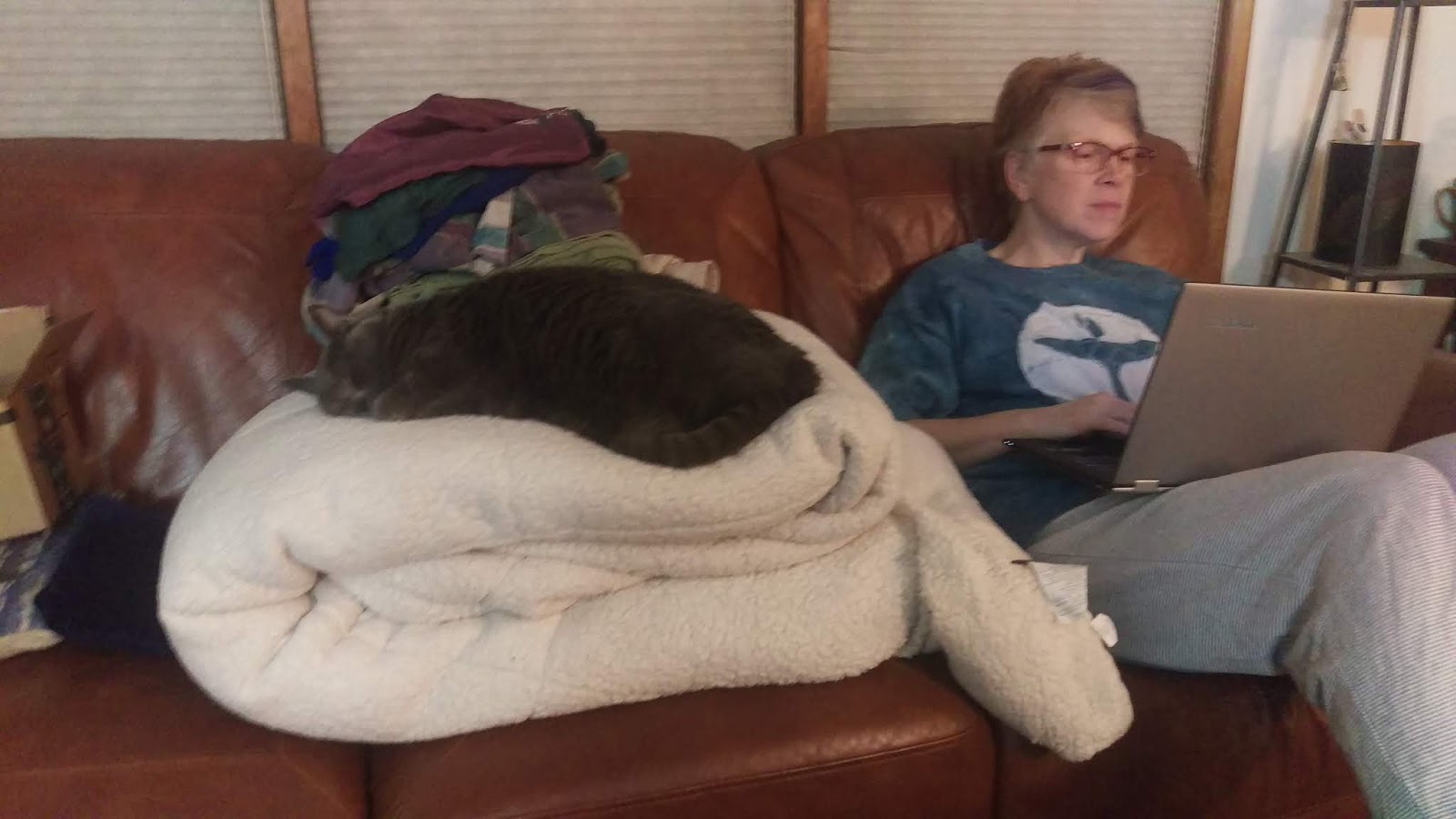
Annie Cat joined our household about 5 years ago and she does an excellent job job: being soft. She helped me heal during chemotherapy by snuggling on my lap during the day and by my side at night. She will lay in wait on the foot-board of the bed, then reach out and put her paws around your neck as you pass so that you'll pick her up for a cuddle. (In the photo to the left, you see that Annie likes soft things. She found the comforter that was on its way from the dryer to the bed and decided it made a good cat bed.)

Isabella Dona Pugellini, the pug, is super smart, and is very much an elder dog. My spouse enjoyed teaching her lots of tricks and showing off her obedience and agility skills. Now she's stone deaf and nearly blind. We are very grateful that knows hand signs so we can still communicate with her a bit. She is bossy, inquisitive, and spreads garbage around the house if it isn't locked down. Our household shared custody of her until the last couple years so I never really developed a relationship with her, but she's a member of the family, so she gets my loving care just like the others.

Clean Floors

They are aging. Slowly we've been adjusting our living around their needs. Getting garbage pails with lids and putting bricks at the bottom edge of the fencing worked when they were younger. Now our geriatric pets need more accommodations. Baby gates prevent accidents in areas of the house that are hard to clean up. The mop is kept handy. We have invested in doggie diapers and specialty enzyme cleansers. Ironically, the floors are cleaner now than ever because they get mopped sometimes twice a day. They are let out into the back yard frequently, and the pug needs to be rescued when she gets lost around a corner. The already inattentive beagle has started to go deaf so he has to be watched carefully or hooked to a line. Medication refills keep them moving and a special ramp helps the pug get in the house.

Aurgh

Sometimes I am frustrated. Sometimes I hear the voice inside that is at its wits end saying: "when they die we won't have to be embarrassed to have people over, we won't be cleaning so often, we won't be spending so much on meds..." When that happens I know I'm moving too quickly. The beings we commit to (whether they are furry family or human family) deserve our care through both health and sickness. They did their job, and paid into their "social security." It will be our responsibility to help our pets move out of life when it is time, and we'll be faced with the impossible responsibility to determine when that time is. Until then, it is our responsibility to give them a safe life, free from want.

Everything I learned

Just like pets, people come with hardships and messiness and complications. We don't get to shop for the perfect family members, but we can learn how to deal with that messiness by looking at how we deal with our pets.

Our pets, our children, and all our loved ones depend on us. The relationship between dogs and humans evolved many thousands of years ago and now we rely on them as they rely on us. This is also true not only with families but in society. The fact that we have the ability to care for them, and that they cannot survive without us, morally obligates us to pay attention to how we care for them. All of them! We, as a community, are responsible for the strays and the lost, those who have been displaced or abused, and those who are neglected or broken.

Facebook and Youtube videos of kindness to animals - wild animals and pets, injured animals, homeless animals, and disabled animals - abound. They get shared and "liked" and they seem to make people feel good. It is good to be reminded that we humans can act on compassion.

We can learn from them.

We can learn that displaced human children deserve just as much compassion as a baby squirrel.

We can learn that disabled people deserve just as much compassion and accessibility as a cat.

We can learn that we can feel good about saving the life of a person living on the street just like we can feel good about saving the life of a dog that has gotten into danger.

Having pets can give you practice for having relationships with people. It feels really good to make a difference in another life. May we each find the lives that we will bless. We have much to give, and there is much need out there.

Sunday, May 13, 2018

Spiritual Growth through "Moon Forest Bone"


Moon*Forest*Bone Wisdom- for healers, givers, and change-makers. who are adrift and yearning to conspire with divine love to learn and live your gifts.

https://www.nasa.gov/image-feature/
goddard/lro-earthrise-2015

Moon

Our Spiritual Development emerges from our relationship with the celestial, because the tides affect us all, the majesty of the Sun and Moon and Stars inspire us and the mystery of the universe gives us humility and wisdom. Deities move between, among, around and through us.

by @OregonGirlRebecca

Forest

Our Spiritual Development emerges from our relationship with the place we occupy because we are each a tree, drawing nourishment from the earth and giving the fruit of our living, our gifts. Because the forest we are in forms us and supports us and is our tribe. The wisdom of the land we are rooted in fills us and the wisdom of the people around us creates us. Indeed, your relationship with the place where you are planted is sacred.

Bone

Our Spiritual Development emerges from our relationship with our identity because we have wisdom in our bones and bodies, wisdom that comes from our biological heritage, our family, our ancestors of body, culture and and spirit. We grow from the wisdom passed down to use from teachers of many traditions.

Saturday, May 05, 2018

Lusty May

Lusty May

On the calendar the lusty month of May begins with May Day, In Slavic countries it begins with Green Week. Astronomically the midpoint between Spring Equinox and Summer Solstice is around May 5. And all around the world May begins with International Worker's day.

A day and a week of celebrating Spring, emerging growth, fertility, love and joy. And a day, throughout the world, of acknowledging the labor of the workers: International Worker's Day. A time to recommit to our community and our solidarity…to promote the legal establishment of safe and fair working conditions, and to act for a world of love and justice.

The worker day and the flower day, occur on the same date and even though they are different, we can celebrate them together: a celebration of the renewal of spring and a celebration of the work we all do, and the people who labor. We celebrate renewal of the self and soul so that we can enter into the work with new energy. We glorify our work, “whistle while we work,” let our lives be songs, and do the work that must be done.

Appreciating the work that the land does to create food and shelter and beauty to sustain all that lives need not be separate from appreciating the work that the people do to create food and shelter and beauty to care for the earth and the people on it.

My May Heritage

"Love has no Labels" credit Brian Emerson
In my pre-Christian Celtic, Norse, Gaulish, and Slovak cultures May Day was all about the joy of young love and human sensuality and sexuality. It is written that in Great Britain, France, and parts of the American colonies on the first day of May young men and women would go out into the fields to celebrate spring with acts of love and pleasure. In so doing, they would bless the crops, and be blessed with fertility by the land.

This tradition has continued in some areas as a sort of day-of-rule-breaking. That fits the tradition well. The immigrant Americans of the early 1600’s who celebrated with may dances and costumes were the hippies of their day. They wanted peace with their Native American neighbors, not war. And they weren’t interested in the uptight rules followed by their puritan neighbors. The most famous group settled in merrymount, which is quincy MA now. The stories of that settlement make great reading!

Morena and Vesna


Morena doll
In Slovakia girls of the village carry a straw effigy of the goddess of death and winter: Morena, to a local stream. To banish winter they set it on fire and throw it in a defrosting stream. This symbolises the end of winter and the arrival of spring, the end of the domain of the death Goddess and the beginning of the love goddess: Vesna.

Lots of cultures burn straw figures to banish something. I've personally attended many rituals that included burning slips of paper. We first would write something we wanted to get rid of on the piece of paper, and then we'd each throw our paper into the fire.

May was traditionally called the month of love in Slovakia. In this period, a maypole tree was the most important of all plants. The maypole was usually a spruce without bark, whose top the boys had decorated with coloured ribbons. On Mayday, people still erect maypoles, usually on the square or in the middle of the village. In the past young boys erected maypoles for young girls whom they wished to court, or all young boys erected a maypole in honour of all young girls in the village. Throughout Europe, the May Pole has been one common way to celebrate May Day for centuries.

In Scottish Gaelic, Latha Bealtainn (pronounced "laah Bahl-tinnuh”) or “Beltane” is celebrated at the beginning of the month of May. Bel-Tinne was a time for blessing livestock. Great bonfires were lit and the cattle were driven between them from the winter pasture to the freedom of the summer pastures.

Fire and Dancing


Slovak Green Week, Fire Leaping
Jumping over the fire is a custom that existed in all parts of Europe and its purpose was to ensure fertility as well as to protect people and cattle from evil forces. The fires, the maypole, Jack-in-the-Green parades, May Baskets and crowning of the May Queen are Beltane/May customs that survive today in the United Kingdom and have been embraced by many Neo-Pagans around the world; celebrating Spring, purifying and ensuring fertility.

These celebrations are snatching life out of the jaws of death. When we lose someone we want to hold those who we love even closer. When we come to the other side of pain or privation we want to dance and sing. Even when we are still just barely defrosting from hardship, fear or sadness, we want to light a fire, to remind us of what warm and joyful feels like! And always, we need community.

Slovak, Walking with the Copse/Queen
I went through this daily when I was a chaplain at a hospital. After a day of visiting with the sick and dying, fearful and despairing, I’d stop by the new babies window and smile at the sweetness of new life. Those babies cast a magic spell that conjured renewal so I could return and give again.

Slovakia has their own version of May Day baskets. It’s called Walking with the Queen. pine branches, twigs or even entire small trees– adorned with ribbons, handmade ornaments, egg shells or flowers – are carried from house to house. The copse is usually carried by girls, who walk from house to house, dance, sing and extend best wishes to the hosts. In this ritual they are casting a spell, or conjuring up blessings and relationships in the community.

These rituals announce the coming of spring, a time of joy and song, a time when the Earth bears new fruit. And they connect the community.

Lust as Thirst


The lust of May is a lust for life, a thirst for life, a love for life. This thirst to live fully and joyfully, and this love of living things, is what gets me up in the morning willing to do the work I must do.

The love we have for our own children, our friends, our pets, and the land where we live motivates us to care for them. We as humans, universally, feel responsibility for the whole web of life.

The workers in U.S. factories of the turn of the century reached across their different languages and cultures to fight together because they didn’t want their children, or their neighbors’ children to have to labor in dangerous factories.

International Workers Day, or Labor Day was initially called for at the international Socialist Congress in Amsterdam in 1904. They called for demonstrations to push for the legal establishment of the 8 hour day, for the class demands of the proletariat, and for universal peace. and they instructed all workers to stop work on the first of May. - to take a holiday.

Let’s celebrate May Day


From MayWorks
One of the chants used by strikers and demonstrators of that time was “Give us bread AND Roses”. They wanted both bread (wages) and roses (time for the activities that nourished the mind and soul.) They knew that time for community, for story, for joy was just as important as the time for work.

Let us remember that, particularly now. Let us hold back the tide that is sweeping away the protections that so many worked so hard to get. We need one another to make it. We need renewal, community, joy, and roses.

Let's celebrate May Day by bringing one another bread AND roses.

Sunday, April 29, 2018

May Day Goddesses

Spring Goddesses


Freya, Artwork by Kris Waldherr
Love of life, a lust for life, is beautifully symbolized by Spring/Fertility Deities all over the world. Unsurprisingly, most of them are women.
What did the Spring Deities do for the folks who celebrated and worked with and studied with them?
There are LOTS of answers to this question but I've got three favorites:

  • Story: moral tales and lessons. Telling a story about a fertility God or Goddess changes emotion and belief so much more effectively than saying "Be proud of how you look" or "You don't need to be ashamed of your sexuality"
  • Practicing Presence: Acknowledging the changing of the seasons, tuning in to the world around you. being present to what is true now and what could be. a sense of companionship when all human companions are absent. 
  • Community connections: coming together for feast days and rituals that strengthen the bonds of community.

Finding your Spring Deity

Vesna: Art courtesy of JankaLart on etsy
So, who is your lust-for-life deity? What stories can give you insight and what practices can give you self awareness, agency, and build community

Bone Forest Moon 

I use the structure of "Moon/Forest/Bone" to define my relationship with the sacred.

  • Bone: What images of the divine, what stories and mysteries and lessons, what beliefs and practices have been (or SHOULD have been) passed down to me through my tribe, ancestors, and family?
  • Forest: What does the place where I am ask of me? Knowing that holyness and divinity often comes from direct experience of a place, what has relating to the divine looked like in this place in the past?
  • Moon: What universal human truths and experiences are available to me to work with? What is the cosmic view in which the earth is a blue marble floating in space and the scientific view that seeks to find ways to describe and relate to reality that hold up across many experimenters, many experience-ers.
Flora (Spring), from the villa of Varano in Stabiae
I can tell you about my Spring Deities. I invite you to find who or what might be yours.

Bone

This includes the deities my father's Slovak mother would have known if she hadn't been brought to the U.S. so young. Vesna for the first breaking of Spring and Lada for the fertility, love and warmth of Summer. There are also the deities of my mother's French/Gaulish and Scottish ancestors and my father's English ancestors. Artio from Gaul, Celtic Olwen, and depending on which historical period of the British Isles you want to focus on, Freya from the Anglo-Saxons or Flora from the Romans. your heritage might lead you to Oshun: The Yoruba Orisha of rivers and beauty and sensuality, Or Ishtar from the ancient near east and Sumeria, Kono-Hana-Sakuya-Hime from the far east. or Atabey, the Taino Goddess from the Caribbean.
heritage isnt the only place to seek for symbol and sacred meaning, you can also open your awareness to the here and now.


Forest

Gaulish Muri Statuette: Artio

I live in the green Willamette valley at the confluence of two great rivers. Spring begins with flowers in March and by May we have planted our gardens and are cleaning up from the muddy month of April. My deities of place are Mount Hood, known as Wy’east, the Willamette river, and the hazelnut trees. Take a moment to reflect on the sacred places and things right here.

Then you can also seek among the Universal.These images of the most holy will resonate across place and time and culture.

Moon

Kano-Hana-Sakuya-Hime
The cycle of the earth around the sun, the tilt of the earth, the changes of the temperature and day length... All these things are experienced by human beings in all parts of the planet. The experience of falling in love, of birth, of losing and regaining health are all experiences shared by human beings everywhere. My deities of the cosmos are Love, Birth, and Joy. They are the Sun and Heat and Fire. You might share some of mine or have a few others that especially resonate for you.

----------------
Reverend Amy invites you to find your own spiritual direction through a relationship with the sacred in the domain of Bone, Forest or Moon.

Sunday, April 22, 2018

Earth Day 2018

Concept: Ian Ridell, Art: Kimberly Debus

Seventh Principle of Unitarian Universalism


Art by Mare Cromwell
RESPECT FOR THE INTERDEPENDENT WEB OF ALL EXISTENCE OF WHICH WE ARE A PART

What did you do today that connected you to the earth?
What did you do today that you can point to and say: “That was the seventh principle at work in me”?

Gaia


When I think of my relationship with the earth I think of Gaia. Gaia is the Greek word for the goddess who is the earth, but what I’m talking about is Gaia as the idea, put forth in the 70’s, that the entire ecosystem of earth is one being. A being that is made up of rock and plant and animal. A being that breathes and lives. And we humans are a part of that being.

Process theology tells us that everything is made up of many other things. And that all of these things aren’t even things, they are processes. The planet is a collection of many processes, just as each person is a collection of many processes. And there is really not much distinction between the process that is one of my cells and the process that is the earth or even the solar system. We are all containers of many other things. The chalice of the earth contains us, just as we contain myriad forms of life. The earth is a green growing container, a chalice, if you will. And so are each one of us.

Have you seen the video going around the internet that is narrated by Julia Roberts? The visual is fly-bys of these spectacular places on our planet: orange and brown desert canyon; frothy white jungle waterfall framed in deep green; stark pale blue arctic ice floe in endless sea… In it Julia is the voice of Gaia, and Gaia is reminding us that she has existed before us, and will exist after us. She doesn’t much care if humans make ourselves extinct. She doesn’t need us. She is so much bigger, so much more, than an earth lifeboat for humans. We need her.

This can come as a bit of a shock. Or it can help us to feel our dependence, and our connection, with the natural world. Indeed, our oneness with the natural world and all that makes up the earth.

Viriditas


The other concept I think of when thinking of our relationship to our earth lifeboat is the idea of viriditas. That idea that the divine is the greening life-five was articulated by Hildegard von Bingen. “Hildegard of Bingen”, also known as "Saint Hildegard" and "the Sibyl of the Rhine" lived from 1098, to 1179, in Germany. She was a Benedictine abbess, writer, composer, philosopher, mystic, and visionary who wrote theological, botanical, and medicinal texts, as well as letters, liturgical songs, and poems. She is considered to be the founder of scientific natural history in Germany.

A cornerstone of Hildegard's spirituality was Viriditas, or greening power, her revelation of the animating life force manifest in the natural world that infuses all creation with moisture and vitality. To her, the divine was manifest in every leaf and blade of grass. Just as a ray of sunlight is the sun, Hildegard believed that a flower or a stone was God, though not the whole of God. Hildegard celebrated the sacred in nature, something highly relevant for us in this age of climate change and the destruction of natural habitats. - The definition of viriditas or "greenness" is an earthly expression of the heavenly in an integrity that unites dualisms.

Mandalas


One of Hildegard’s spiritual practices was to draw her visions. We, in this modern world, call them mandalas. Just like the mandalas created in India and Tibet, her mandalas were visual patterns that represent the cosmos metaphysically, spiritually, or symbolically.

When you truly believe in and value your relationship with the earth, or God (and for Hildegard those were the same) you act on your spiritual connection. The Church of her era was rife with corruption and sexual misconduct. While many men held back from protesting, fearing the repercussions, Hildegard decided that she would take on the mantle of reformer. Although St. Paul had forbidden women to preach, Hildegard embarked on four preaching tours in which she delivered apocalyptic sermons to her male superiors, warning them that if they did not mend their ways, they would fall from grace and be toppled from their seats of power.

Nor did Hildegard enjoy a quiet retirement. She took in and nursed a man who had run away from fighting in the crusades, and when he died she buried him in the churchyard. It is hard for us UUs to imagine, but giving this Christian burial to someone who rejected the command to fight in the crusades didn’t sit well with the powers-that-be and she and her nuns were collectively excommunicated. The excommunication was only lifted a few months before Hildegard's death in 1179.

Acting on Your Spiritual Direction


Hildegard didn’t just pray with words. She lived her belief that every person was sacred, that her love of Viriditas must be expressed, that the church, her communities, and yes, the whole world was worth her time and energy, risk, and commitment. What does your relationship with the earth, or the divine ask of you? We need to listen to our heart songs, our earth songs, the voice of viriditas, the sacred, and we each need to find our own spiritual direction, a direction that lives our love for our world.

Hildegard speaks for God, saying: "I, the fiery life of divine essence, am aflame beyond the beauty of the meadows, I gleam in the waters, and I burn in the sun, moon and stars ... I awaken everything to life." -- Hildegard von Bingen, Liber Divinorum (Book of Divine Works)