Sunday, March 18, 2018

Ostara: The Vernal Equinox

Folklore connects egg balancing to the 
lunar new year in China, the Dragon Boat Festival
 in Taiwan 
and vernal equinox in the US. 

Egg balancing can be done throughout the year
What do Carl Sagan, Merlin, and the March Hare have in common? What can the egg balancing trick teach us about living in this world?

"Ahhhh, Spring: a heart lifting in hope and a shoe squishy with mud."

On St. Patrick’s day I think about the wisdom contributions of Celtic people. One of the most famous Celtic sages was the Welsh wizard, Merlin.


Merlin

During WW I, T.H. White, an English author and Naturalist living in Ireland decided that war is one of the worst evils human beings visit upon one another. He wrote “The Once and Future King”, the story of King Arthur. In the book the bumbling wizard named Merlyn advises the young Arthur and teaches him about using strength and wisdom in service to peace.

Merlyn turns Arthur into an ant, and then into a goose. As an ant he experiences life in the totalitarian state, obeying orders. As a goose he feels the wind in his face and the mud under his webbed feet. He feels the camraderie of the whole flock flying together. Merlyn is teaching him ethics, and politics. He learns that structure is important but so is freedom. Both/and.

The Vernal Equinox

We are creatures of the land we live on. All during the short days of winter our rational minds know that the sun will return. But there is something deeper that despairs, yearns, and suffers in the dark. At its worst it is diagnosed as Seasonal Affective Disorder. It’s cure: the return of the sun. Our climate, the land we live on, tempers the way we think of what is holy. It determines, even in cities, many of our habits and rituals. The natural cycles are in us.

March 21 is the Vernal Equinox. The mid-point between Winter and Summer, and the official first day of spring. This is the time of the emergence of green. We are tipping over, from the fallow death of winter into the exuberant spring. This is a time when we see the holy in nature. As Hildegard of Bingen said: “God is Rich and Green and Juicy!”

Photo by Hawthorne Post

In New York, each year when the cold snow had ended and the first gentle spring rain began to fall, I would set down my computer and run out into the street. I’d breath in the fresh scent. FEEL the warm rain. And LAUGH! This spring I’m watching my beagle roll in the grass, four paws waving in the air, with a grin on his face. And I find myself transfixed by the sun on the camellia buds and the tiny green leaves just emerging from the plum tree branches that just a day ago looked dead.


Ostara

The March Hare. 
Illustration by John Tenniel
Throughout history we gratefully celebrate Earth's annual resurrection. Spring equinox is a time for joy, fertility and sowing seeds. In medieval societies in Europe, the March Hare was a fertility symbol -- this is a rabbit that is usually nocturnal, but in March when mating season begins, there are bunnies everywhere all day long. As if that wasn't enough, the males tend to get frustrated when rebuffed by their mates, so they bounce and run around like mad.

Ostara (1884) by Johannes Gehrts
Many modern Pagans use the word Ostara for the celebration of the spring equinox. Ostara is from the name of a Germanic goddess. Eostre was the goddess of the land, and farm, so she was celebrated as the days became longer, the chickens began laying eggs, and the cows started giving more milk. The depictions of Eostre are like the European paintings of maiden Spring. She’s a joyous woman, with flowers in her hair, carrying a basket of eggs and a bunny rabbit.

It‘s no surprise to find that the bunny brings Easter baskets full of eggs for children! It is no surprise the Christian resurrection story takes place in March or April and in the Jewish faith, Passover takes place as well. Passover, the celebration of the gift of life in the midst of horror and death. This is the season to celebrate the victory of life over death
.

Resurrection

Martin Luther noticed the connection: “Our Lord has written the promise of resurrection, not in books alone, but in every leaf in springtime.” Each tree, bush, and plant that looked dead all winter, has completed its hero’s journey and returns to the land of the living. Indeed, the whole earth is re-emerging from the harrowing adventure of winter.

Tajikistani Girls celebrating Novruz with wheatgrass sprouts
All over the world, people are celebrating the transformation into spring. Naw-Rúz is an ancient Persian and modern Bahai festival which occurs on March 21st. It is celebrated with many symbols indicating re-growth and renewal. The purpose is to celebrate the messages that spiritual teachers, such as Mohamed and Jesus, proclaim. Messages which bring us spiritual springtime. Some celebrations of Naw-Ruz include floating new sprouts of plants down a stream and doing Spring cleaning.

Earth and Sky

Merlin and the earth-based traditions advise us to look to nature and the behavior of the wild creatures for insights into our own nature. How we can become our best selves. I hear that same message from those who look UP, beyond our earth as well.

Earth and sky. Both/And.

Neil Degrasse Tyson says “We are all connected, to each other biologically, to the earth chemically, to the Universe atomically.”

And Carl Sagen: "The world is so exquisite with so much love and moral depth, that there is no reason to deceive ourselves with pretty stories for which there's little good evidence. Far better it seems to me, in our vulnerability, is to look death in the eye and to be grateful every day for the brief but magnificent opportunity that life provides.”

Beauty and love on the one hand, death on the other, skepticism on one side, openness on the other: an exquisite balance.

Kraslica is the art, in Slovakia, of painting eggs,
more commonly known by the Ukrainian name:
Pysanki. In memory of my Slovak grandma.
Photo by Luba Petrusha

Translated literally, equinox means "equal night." It is an astronomical term. Equal day and equal night. Both/And. We can’t have one without the other.


I imagine my grandparents on their farm in Upstate NY. Checking the root cellar and seeing that the jars and boxes of precious food are depleted… worrying. Checking the seeds stored and waiting… ready to plant to grow more food: the end, and the beginning, both together. Those seeds came from the death of the plants. Life can only return after the descent into death: Life and death. These opposites are both present at this time of year. Both/And.

Balance and Harmony

If we practiced this embrace of both/and, perhaps things that seem to be irreconcilable could co-exist with one another. We would appreciate the value each side brings. Western and Eastern healing modalities, both Muslim and Christian wisdom, both activists and mystics, both Black kids facing death and proclaiming #blacklivesmatter and White kids putting shoes on the capital lawn to represent those killed in school shootings... both/and.

Taking up both/and as a spiritual practice means taking the time to pay attention to how our lives are in or out of balance. It means paying attention to what is present and what is absent. It means welcoming the fallow time, and then welcoming the green growing times as well.


Tauʻolunga - Own work
I invite you to breathe with me. Breath deep.

Feel the polarities in this moment – Earth as our home is poised in relationship with the Sun. Feel for your own embrace of day-light and night-dark within, your own balance of old and new – this fertile dynamic of tensions. Both/And. Reach out and wrap your arms around it.

Release your breath into it. Breathe in the light, swell with it. Breath out. Let your breath go into the dark, stay with it. Shift on your seat, from left to right, forward, back, feel your centre…breathe it in.


1st day of Falgun in Bangladesh Photo by Ibrahim Husain Meraj

In my part of the Earth, the cycle is about to tip into new growth, into the light. In the southern hemisphere the same balancing moment is about the tip toward dark. Feel the shift within you, see in your mind’s eye the energy ahead, the light expanding and contracting. Feel the warmth of it. Breathe it in.

Ahhhh. Spring: a heart full of hope and a shoe full of mud.

Come, Yet again, Come!


--
Join Amy's mailing list.


Blessed be.

Sunday, March 11, 2018

Visiting the Goddess Temple North of Las Vegas

Every year we travel around the South Western United States. I preach each Sunday at a different UU congregation, offering retreats, and meeting with folks for Spiritual mentoring. This year we took a side trip to visit the Temple to Sekmet North of Las Vegas, NV.

I will share a bit in other blog posts about the visit to Sedona, Grand Canyon, San Xavier Du Bac, and other locations in this 2018 trip, this post is about Sekmet and golden hour in the Nevada desert.

You can learn about the founding, funding, staffing, and story of this temple from their web site.

Hawthorne and I drove up mid-afternoon on a late January day. It was breezy and low 70's. The sun was out (Yay! Sun! That's part of why we were down there... it will be GREY back home in the Pacific "NorthWet" until late Spring.)

Despite careful directions shared by the caretaker and priestess over the phone, we almost missed the exit. The temple is close to the Missile Test Site and Creech Air Force Base. Like Seneca Women's Encampment near the Upstate NY Seneca Army Depot, I expected a theme of defiance and opposition. I was happily disappointed! The Temple is not existing in opposition to the military. My sense is that though the peace of the land is a contrast, it is not defined by the military base and former missile test site near it.

We entered from the parking lot by the residences. Small house. Small trailer. RV with hookups... Cats! Right away a beautiful black cat came out to visit with Hawthorne. We were missing our kitty back in Portland. It took me a while to connect the obvious... Sekmet is a CAT Goddess. LOL How appropriate.

This site is well taken care of. It is the desert so the colors and landscape are a little strange to my forest-adapted Oregon-eyes. The caretakers were clearly giving it love: no trash, little signs of tending along the paths and in little shrines.

The grounds are minimally accessible to people who are mobility impaired. The desert actually helps in that respect, here in the Pacific Northwest mud and fallen trees are constant sources of obstacles.

The outdoor conference area looked well appointed and inviting for mild Fall-Spring days. And then the path wound around another corner.

A painting of Sekmet on the side of a shed was brightly lit by the lowering sun. 

Up the hill, a cob structure with interesting features invited us forward.

Inside the Goddess is represented by Sekmet, the Madonna, an Earth Mother and other smaller myriad goddess images. The ground was tiled with flagstone and colored rock and glass beads.

Inside, a fire circle is ready for rituals. Each stretch of chain protecting the fire circle represented a phase of the moon. 

The Madonna was present in many variations and meditation pillows abound. 

Standing inside the temple, reflecting on the earth goddess statue, I shifted from idle curiosity to a sense of deep appreciation and reverence. Peace moved through me and I paced slowly, meditatively around the fire pit enjoying the glitter of the stones and the details of the goddess figurines and statues. Incense invited me to move deeper into the experience and I lit some and knelt before the earth goddess receiving the opportunity to feel at one with the cosmos.

Another devotee approached and I put out the incense, drew some symbols I find sacred on the stone, and left the structure to face the sun. Time for the sun salute!

While the new arrivals got to work watering plants and neatening the space, I moved along the trail to enjoy a slow stroll through the labyrinth. 


Then, Oh! Delightful: a collection of shrines to the fairies and nature spirits!

Also on the grounds we saw a small performance area and a council circle. 

Parking near the temple was ample for large gatherings. Next time we are in Las Vegas we'll check to see if anything is planned and make a point to join with others to commune with the land and the peace and healing of the Goddess energy. Thank you Sekmet and the Priestesses of the Goddess Temple!

--
Add your self to announcements from Amy.

Sunday, March 04, 2018

Sunday, February 11, 2018

Trans-Parents

I'm married to a great guy, his son calls him "Mommy"

My spouse is completing transition. He was assigned female at birth but he's always known he was a guy. There's a period of "coming out" and a period of moving along a continuum from being perceived as a masculine woman toward being perceived as a feminine man that requires new safety management techniques.

(Before you ask, I knew before we got married, and I am still, six years later, absolutely sure that I'm the luckiest woman alive to have this person as MY person.)

Transition: a Journey, not a Sprint

Credit Creative Commons
We live in Portland Oregon. That means that there are some gender neutral bathrooms available, and it feels safer than some other towns. That hasn't changed the fact that going to the movies can be stressful - for a while I'd go into the women's restroom with him so that other women would feel more comfortable. Then there was the period where neither restroom would do and we would sprint home after a long movie, or skip the soda! Now he feels comfortable using a men's restroom in most places in Portland, though I worry...

Now a whole new challenge has shown up. When we go out to eat, we use my credit card because his still has his old name on it. When we forget, and he pays, the waitperson gets all weird when they see the old name on the card and realize they must have been "wrong" about his gender the whole time they served us. Worse, at the doctor's office, when the nurse comes out and calls the old name my husband has to decide if he will answer, thereby outing himself to all the people in the waiting room. Is that safe?

We are working on the name change, but it is tricky. You don't want to change legal name while you are in the middle of selling property, for instance. We do want to get renewed passports and we want to travel. Now that's another area of concern. Traveling... Where can we travel safely. What do we need to think about for safety when walking down the street in Phoenix Arizona? What if there is a medical emergency, will the emergency room doctors respond with care or confusion? Or most terrifying, with a refusal to treat him!

Family Transitions R Us

Our son has special dispensation to call my husband "mommy" since he's been using that name for 30 years. But will that work when we are visiting our grandchild in Arizona, sitting in a restaurant? And what will our seven-year-old grandson call us? He was a perceptive 4 year old who had a really hard time applying "grandma" to my husband, because my husband didn't seem like a grandma to him. That astute little boy settled on "Daddy's Mommy" at the time. (I've always been an easy "Grandma.") We have been trying "Granpama" but last month "Grandpa" began to win...

My own experience with his transition is worth a separate blog post... I've always had an ambiguous relationship with the way I can pass as a femme woman, and my friends who are butch risk so much more just living in the world. It is bizarre how my safety from homophobia swings from high alert when I'm with certain friends to complete unconcern when I'm "passing" as straight. Now that sense of "having it easy" in comparison to people of color, gender non-conforming folks, etc. is intensified when I realize people respond to my family as a straight family. I now have a husband, and I'm allowed into certain spaces in a way I wasn't before.
photo via flickr under the Creative Commons License

All of this Could be Easier

Our lives are really pretty awesome. And we are lucky to live in Portland, and at this time in history... And, it could be so much easier if allies and professionals were just a little more aware and attentive. And of course, I pray for those who are made uncomfortable to pay more attention to their own moral behavior and their own opportunities to learn and grow. I pray for them to spend less energy on judging and meting out judgement on others.

Meanwhile, my guy and I are living our lives, still in love, taking care of the dogs and cat, laughing together, learning together, and having adventures.


Here's a fabulous resource for Allies!

And here's my guy's blog.

Sunday, February 04, 2018

Wrestling with Ableist Language

Not Done Yet!

Graphic from UU Congregation of York
Whoops. I just realized that my business name uses ableist language. Aurgh. I just heard someone talking about using "walking together" as a sermon title. Dang. I heard from my dear friend that, yet again, our organization picked a theme that included "standing" in the title.

Did not the UU movement just embrace a commitment to undoing ableist language? But that one vote this last Summer didn't finish the project. We have years of tried and true metaphors to catch, examine, and release. We have language passed down to use from our heritage. We have habits and we have internal resistance to overcome. 

Please tell me that you are finding ways to sing, work for justice, explore, move and develop spiritually without restricting that to people who can “stand” on the side of love or “walk” a spiritual path. (The UU justice organization made the change from "Standing on the Side of Love" to "Side with Love". Jason Shelton, the author of one of our favorite hymns made the change from "Standing on the Side of Love" to "Answering the Call of Love"... we can all be inclusive too!)


Walking and Rolling on Our Own Paths

And of course... each person can and should use whatever metaphors they want in personal conversation. I’m talking about hymns in worship, the names of organizations, slogans, newsletter titles, etc. places where one is representing more than just yourself... Where a higher standard applies. (As far as individuals, your approach and choices may vary based on context-it is cool to pay attention to the words you use, but I’m not here to shame you for your choices. We all have days when it is all we can do to use words at all, much less examine them for inclusivity. The less marginalized your identity, however, the more important it is to consider the experience of he marginalized folks.)

Let me be clear here. I did not say (and would never say) you should purge such language from your vocabulary. But good grief. A major slogan that represents our justice aspect of our movement? A significant hymn? The name of a congregation? The go-to metaphor for rituals? The title of your newsletter or CUUPS group? Heck no! That’s a completely different thing from using a variety of metaphors in daily speech. We don’t need to “police” personal conversation. We DO need to be mindful of using ableist language in official and high profile contexts.

And... I find the experience of searching for new metaphors and different language to be freeing and exciting and fruitful. I personally am happy to monitor my language for body-based metaphor and make thoughtful choices. YMMV.

Updating Beloved Prayers and Songs and...

Photo from 2017 UU General Assembly
I have a prayer that has been incredibly important to me that I still want to use only referred to daughters. So I changed it to sons and daughters. Then I became aware of how that excludes gender non-confirming folks. So now I don’t use it in worship... waiting to see what might unfold there. Mary Kroener-Ekstrand, who is a DRE, mentions that "Our UU youth often use the phrase "siblings in spirit" in one song in place of sisters and brothers..." I love how our youth lead us in many of the invitations for more compassion! (See the prayer below. And your suggestions are welcome!)

I’ve been sharing a worship service called “living like a tree” based on Betsy Rose’s song “Standing like a Tree” so I talk about using that as a mantra and invite the congregations to use “living” instead of standing... and to feel how that works as a mantra...

And I’m owning the fact that I didn’t realize that my own business name was ableist until I began writing this (I've been using "Listen to Heart Song" for four years now. It is time for me to find a better, more resonant, and more inclusive business name. I welcome your suggestions!) I’m by no means perfect. But I have found that engaging these questions makes me a better person.

Diversity in our Diversity

My friend from college, Shulamit Levine-Helleman, points out that different communities (and individuals) may have different preferences. Shulamit says, "being autistic is part of who I am, not something I have, so I say I am autistic. My physical difficulties, on the other hand, are not an intrinsic part of my identity, and what is disabling is not my physical condition but the barriers placed by society, so I say I have a disability. We should respect the preferences of the individual, not impose person first language in all cases." We humans really want to be right. But which way is RIGHT? Well, that depends!

ADA
I was taught to use "differently-abled" for anyone with a disability. That was the RIGHT WAY. (You know you are about to get into trouble whenever you think you know the one "right way.") And then folks told me that they get to choose what they want to be called, and "differently-abled" isn't it! Part of this work is dealing with the messiness and evolving language. I’m still growing into using “they/them” language and “queer” since I came of age back in the days of “wimmin” and “lesbian” Lol. Alex Kapitan, Radical CopyEditor, has this fabulous comic about exactly this: https://radicalcopyeditor.com/.../person-centered-language/

Rev Maureen Killoran points out that [her grandkids] "exclusion is not from the language of "listening/hearing" but from the exclusive assumptions that shape our hearing world." and Rev Michael Tino points out, "metaphors often shape those assumptions, so we need to use them carefully."

Kristin Bakalar

Attending to Language as Transformative Prayer

Usually it is easy to switch to more inclusive language. And I love the thrill it gives me when I feel that sense of expansiveness...when I pause to notice the way I use language about bodies it invites me to be inclusive of the actual humans before me. It is a type of praying...

As a my Facebook friend Susan Christie says, "I've had similar challenges (and a sense of expansiveness) in trying to reduce images of war, violence, and fighting in my language. It's very hard!" And Rev. Tandi Rogers comments "I also get a rush when we inch toward including ourselves and other people we love."

When you pause to consider that not everyone stands to sing because you pause to say "Please rise in body and/or in spirit to join in singing...", then you are opening your awareness to those individuals who cannot or do not stand for singing. You might change the way the chairs are set up so that seated individuals can see the lyrics. Pausing to attend to the potential needs of these individuals in your words is an opening to attending to the potential needs of these individuals in your actions. 

From Words to Action

Yvonne Aburrow
Does your ritual have a way for hearing impaired folks to hear you? Does your worship circle have an opening for people who use scooters or wheelchairs? Have you checked in with your neurodivergent folks to find out if the singing bowl will be painful to them? Is there a scent-free area? Slowing down long enough to rewrite your prayer or song or speaking part can be a powerful way to turn thought into awareness and awareness into action. And ultimately, inclusive action is how we remove the disabling barriers and create the beloved community.

-------------------
The prayer I used to sing (and used to invite others to sing with me) is by Susan Arrow
Thank you mother earth
Thank you sister water
Thank you for my birth
Thank you from your daughter (which I changed to Thanks from you sons and daughters, could be "Thanks where 'ere we wander")
Thank you brother sun
Thank you air in motion
Thank you everyone
Earth air fire and ocean.

This prayer is very dependent on the Gender Binary. So I have left it behind. I would love an alternate prayer or a rewrite. (Can anyone find Susan Arrow?)

-----------
My business name has been "Listen to Heart Song". That is able-ist in that it relies on "listen" as a primary way of being in the world. For now, I'm changing it to "Reverend Amy, Spiritual Direction." If you'd like to play with a new name with me, join my facebook page at https://www.facebook.com/revamyspiritualdirection/


Sunday, January 21, 2018

Banish the Prosperity Gospel

Good Girl versus Bad Girl

One day in high school I split my slacks. Mortified I sidled into the school office, backpack drooped strategically over my exposed backside. There, I asked to use the phone so my mom could drive to school and drop off an intact pair of pants. While I was waiting for my emergency delivery the school secretary expressed her praise for my excellent choices and good thinking. Clearly I was a “good girl”, unlike the other girl, last week, who had solved a similar predicament in a different way. This “bad girl” had left school property to go to the nearby mall to get her jeans mended.

My class privilege analysis wasn’t very developed back then, but even so, I knew something was wrong with the school official’s judgement. I wasn’t “good” because I had a stay-at-home Mom. The other girl wasn’t “bad” because she handled her problem herself. Maybe her mom worked, or maybe she didn’t even have a spare pair of pants. Those were accidents of birth. These facts pointed to the privilege I enjoyed and that my dad worked to maintain.

As an adult I know that even he didn’t earn that privilege… He had it because his parents could afford to send him to college, (with the help of the government in that WWII period.)

Privilege and Options

Source: Miriam Dobson
I remember that day often. The illusion that having options means you are “good” and not having options means that you are “bad” distracts us from the truth. Of course, I have other privileges, like skin privilege and education privilege and the US of A privilege, that give me options as well. We sometimes talk about these dynamics as intersectionality. This is a topic, many topics, for other days.

Once I started paying attention I started noticing all the ways that we equate “net worth” with “worth” in our capitalistic world. There’s even a religious group called “The Family” that explicitly preaches that those who have money are blessed by God. I don’t mean they preach “thank God for what you have.” I mean, they preach that they can tell who is in God’s favor by looking at their bank account. This extremist group (look them up, their connections to U.S. Senators are truly frightening) is not alone. The prosperity gospel can be traced from Puritanism and permeates through much popular religion and Christianity. The idea is basically that God rewards your faith with success and prosperity. Poverty is a sign of lack of faith and God’s disfavor. Class dynamics and the poison of the prosperity gospel are laced throughout politics, business and white culture.

Earth-Relating UUs and Class

A handfasting ceremony at Avebury in England,
 on Beltane, 2005
Then there are the ways that these dynamics play out in UU Earth-Relating communities. I have been asking myself for a few years now: why do I notice a tension between UU congregation leadership and Earth-Relating congregants around issues of money? Is there a class difference at play between UU leadership and Earth-Relating UUs?

In the 80’s I experienced the Pagan community in Portland Oregon as predominantly white, educated, and in large part “downwardly mobile”. I use downwardly mobile to describe those who were raised with economically privileged backgrounds (landed or educated or simply “comfortable”) who have chosen to do as little wage labor as possible. That decision could be based on a rejection of the values of their parents, a desire to ‘live lightly on the earth’, or to ‘drop out of the system’, or to focus on the values in Paganism that they most resonated with.

When I moved to Ithaca, NY the Pagans I met were true to the demographics I’d observed in Portland. The book “Voices from the Pagan Census,” published in 2003, indicates that the average income for Neo-Pagans is roughly the same as the income average for the United States. The same survey found that Neo-Pagans are significantly more educated than the national average. (92.2% have more than a high school diploma versus 43% of the US population.) This information is consistent with my observations.

I’m aware that Neo-Pagan doesn’t define or encompass the many diverse Earth-Relating religions. People of color, the working poor and other communities have robust Earth-Relating faith groups among them and many Earth-Relating faith paths gather diverse adherents. However, census data no longer includes religion information (as of 1936) and I was unable to find data that would show me average income for Earth-Relating religions more broadly. So many of my perceptions are anecdotal. I’d love to learn more from others out there. Please comment if you have information to share!

Liberal Religion and Class

What I can and do offer is the observation that according to the book “One Nation Under God” published in 1993, Unitarian Universalism is ranked second only to the Jewish community in income, over 50% have a college degree and UUs are well above average in property ownership. This suggests that Earth-Relating UUs will find common ground with other UU congregants around education level but will, on average, have significantly less discretionary income. The book mentions one other thing about UUs. We have strongly been influenced by Puritan theology and the tendencies toward equating hard work with being good. The tenets of the prosperity gospel come with that. But… UU’s have the second principle: “Justice, Equity, and Compassion in Human Relations.” We have work to do here!

This suggests four things to me: 1) Earth-Relating congregants may have a role in educating congregations to be welcoming to income-diverse people. 2) We need to pay attention to how class and means are at play when we find ourselves in conflict, and when we work together to be in relationship. 3) We all have work to do to discover and break the spell of the prosperity gospel that equates means with worth, and we can do that together. And 4) As we dive into class dynamics we must be in partnership with people of color and other marginalized groups, groups who often are economically marginalized, recognizing the other dynamics of intersectionality.

I know this essay is only scratching the surface, and I don’t want us to over-focus so that we forget the impacts of intersectionality. My hope is that I am inviting us into further conversation. My hope is that we are individually and together, casting our banishing spells, in our own ways, on the curse of the prosperity gospel.

Sunday, January 14, 2018

Altaring Spaces

Evoking Sacred Space

Entrance to Ifa shrine and sacred grove of Osun, Nigeria, 
Have you ever paused to appreciate a tree? The ocean? Have you felt lucky to witness family welcoming a loved one home? Or has the pure joy of Fido reunited with his person amazed you? Have you ever wondered at the urge to build the cathedrals of Europe, or the time and effort children put into building and nurturing a fairy castle or fort? These are all ways of creating, evoking, and experiencing sacred space. These are all ways of connecting to the spiritual and the meaningful through our environment.

How do you evoke sacred space and focus ritual through mindful use of objects? Creating sacred space is an art and technique. Sacred space is created in Christianity, earth-based traditions, and modern architecture and practice. What is your plan for creating sacred space in your home, places of worship, and community?

Rituals

Some rituals create sacred space: a Chalice Lighting, a Sage or sweetgrass smudge, Ritual Words like "We are between the worlds, beyond the reach of space and time, joy and sorrow, birth and death" or " Our father, who art in heaven..." and House Blessings.

Dia de los Muertos altar, Wikimedia Commons
Sacred spaces can be created temporarily. The Tibetan Buddhist tradition of the sand-painting is one example of that. March 19th marks the Catholic celebration of St. Joseph’s Day where Catholic New Orleanians construct elaborate altars in honor of this saint. The tradition, commemorating the relief St. Joseph provided during a famine in Sicily, began in the late 1800’s when Sicilian immigrants settled in New Orleans. St. Joseph is the patron saint of social justice. Whole neighborhoods, italian, catholic, and none-of-the-above, participate. Since the altars thank St. Joseph for relieving hunger, offerings of food are essential.

Survey Your Environment

You've heard the phrase "your body is a temple"? How might your relationship to your body change if you understood it to be a sacred place, a temple, a shrine?

What sacred places exist in your home? Your workplace? Your neighborhood? In my home I have an altar with the ancestor photos on it, an eagle feather, a candle, my mother's ashes and a pine cone that looks like a rose that was given me by my son. My neighborhood has small shrines in it where people have built a whimsical or practical holders for free books.

Individual objects can carry sacred meaning. Pick an object that is in your eyesight right now. What story is in this object and what does that object need to do? What is its mission or purpose? For example I can see some clerical stoles that came to me from my grand uncle who was a minister. I have had them for years and never worn them because the symbols on the stoles are not my symbols. Today I decided that the stoles need to be used in worship. They were made for that. So I am mailing them to a colleague who can use them. Whatever object from your own life you have selected, take some time to tell its story, meaning, and purpose. Now ask yourself, "How will I be true to that purpose?"

Go Forth and Make the World Sacred

Photo: Flickr user R, Creative Commons
If you are a part of a worshiping community I invite you to consider the following:
•        How do our worship and gathering spaces present visual cues? Can people who enter that space easily answer the questions “Where am I?” and “What’s expected of me?”
•        How do our worship and gathering spaces offer respite from the outside world? Can people find a place of peace that is accessible and comfortable?
•        How do our worshiping and gathering spaces connect to our history and traditions? What symbols or design elements evoke a sense of the sacred and tell the story of the divine at work in the world?
•        How do our worshiping and gathering spaces integrate elements of nature? How can we bring the outside in and take the inside out?

Pagan Altar, Creative Commons
As you think about your personal sacred spaces and your community sacred places, I invite you to explore the following questions:
•        What might you change about your home?
•        What might you change about your work space?
•        What might you change about your worship space(s)?
•        What spaces and places might you seek out and why?
•        How might you nurture and transform your self through sacred space?
•        How might you nurture community and social justice through sacred space?
--------------------
Reverend Amy offers an "Altaring Spaces" retreat. Join her for the next one!

Monday, January 08, 2018

La Befana on Epiphany

Epiphany


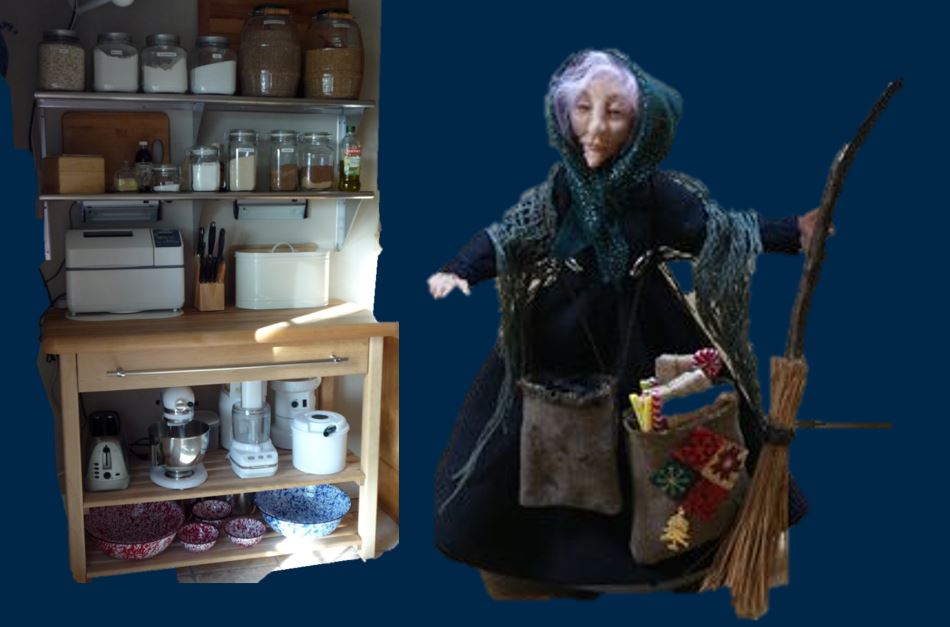
In central Europe and Italy La Befana is known as an old woman, usually ugly, who wears an old, long, skirt with colourful patches, and a scarf over her shoulders. She flies around on her broom, during the night of Epiphany, delivering small toys and sweets to the children.In most Italian regions, even adults give little presents to each other, often stockings full of chocolate.So... You now have an excuse to go get some chocolate, to celebrate Epiphany!


In the story, Befana hesitates to bring her gifts to the holy child. Perhaps she wonders if she has any gifts to give. Perhaps she wonders if her gift would really make a difference. Perhaps every time she’s tried to do something nice before it didn’t work out the way she expected. Maybe she’s grown tired of trying to make the world a better place and she has decided to focus just on her own little house. 

Sometimes it is much more satisfying to clean a house than it is to deal with the messiness of human beings. The house gets clean and stays clean. It doesn’t have a mind of its own, It isn’t ungrateful, and it doesn’t undo everything you worked for in one temper tantrum or one election.
But something happened that made her change her mind. Something made her scurry about doing the things she was good at. Bringing the gifts that only Befana could provide: Her baked goods, her huggable self, her broom.
Three Kings Parade sponsored by El Museo Del Barrio, NYC
Photo Credit: Walks of New York

Perhaps it was the invitation? Perhaps it was the hug? Perhaps it was the joy of the parade? Perhaps it was the hope for a child who would bring more love into the world.
What would it take to get you out of your house? Out of your routine? Out of your safe little cocoon? Out of your projects that seem so very pressing, important, and do-able?

From Birthday Party to Funeral


Things went as planned for the astronomer priests who showed up on their camels at the right time with their expensive gifts. On finding him, the wise men gave baby Jesus three gifts: gold, frankincense, and myrrh. Then they skedaddled. Herod resorted to killing all the young children in Judea, an act called the Massacre of the Innocents, Jesus and his family had, however, already escaped to Egypt.
Angelo Visconti


Here the biblical account ends. I imagine that this is the point in the story where Befanna shows up. After the wise men. After the holy family escapes. After Herod’s army destroys all the new born babies in Judea. I wonder what she thought as she looked at the gifts she had brought and then looked at the bereaved mothers and fathers and sisters and brothers.She thought she was coming to a birthday party and instead she arrived at a funeral. 


2017 Breaks the Mass Shooting Record


Slain in Sutherland Springs, TX church shooting
 26 dead, 20 injured, Nov. 2017
I suspect a lot of us felt that way last year. The year of mass shootings. The year of unprecedented political polarization. The year of rolled back environmental protections. The year of renewed fears of nuclear attack. The year of natural disasters. It was like getting ready for a party and discovering you were at a funeral.

These problems are systemic and connected but we have a tendency to put responsibility for this plague of violence, destruction and suffering at the feet of individuals. Just like la befana looking to the one saviour...If the problems were caused by individuals, if it was about one deranged person with a gun, then we could solve them by having disaster preparedness drills at school/work and learn what to do when there is a shooter in the building. Instead it is about domestic violence, toxic masculinity, us and them and rape culture. (And more)

If the problems were caused by individuals, if it was just that this one elected official is not to our liking we could make fun of that elected official. Instead it is us. We have lost faith in the electoral process. If we dont work very closely, and stick together we will lose access. What hurts some of us hurts us all.. gerrymandering, disenfranchisement, white supremacy, a strategy of divide-and -conquer and a deeply divided country of people who live in ideological bubbles. (And more)


We are All Connected


If only the individual is responsible it feels like it’s enough to recycle. Our frustration tempts us to turn on one another, like when we make fun of teenagers who take long showers during a drought. Instead the blame lies with poor laws and greed, racism and classism. The destruction of our earth stems from the doctrine of dominion over the earth and disconnection from the land, water, and air. 

Our dis-ease is disconnection from our tribes, our communities, our families, our family of humanity and our family of all life. This connection can be called religion, especially if you remember the root derivation of that word. Re-ligio. Ligio is the same word that avenue us ligament… connection. Re-connection.


Photo credit: Upliftconnect.com
If we blame the broken individual, then we are absolved from responsibility to be in community. However, if the problem is that we live in a damaged system, there’s nowhere to hide and so much work to do. We are all part of the system

There is no fast fix. What we need, What we really need is to find ways to connect with one another in kindness and bridge the isolation and disconnection. These men with guns are canaries in this poisoned coal mine. If we pay attention, we can take action to heal that which must be healed.


Hope is Like the Sun


Without the ability to dream, human beings quickly become psychotic. Without hope, we cannot function. Not having a “life dream” is debilitating. Without a dream, living is only going through the motions. Without love, real, personal, connection, human beings shrivel up and die. Like a baby monkey hugging a wire frame, seeking a mother’s love, we all become broken.

In the recent star wars movie, vice-admiral Amilyn Holdo reminded the pilot Poe of a lesson Princess Leia taught her: “Hope is like the sun. If you only believe in it when you can see it, you'll never make it through the night.”


Epiphany is like the sun rising in your own soul. As long as it shines there, we can keep hope alive.

When, like Frodo–the-ringbearer, we despair of our task, we must take Gandalf’s advice.

When we feel that the task before us is too dificult, Gandalf says - "So do all who live to see such times, but that is not for them to decide. All we have to decide is what to do with the time that is given to us."


Redemption


Is there any Redemption to be had from the tragedies of 2017? Perhaps the redemption is our epiphany that something must be done. Perhaps the redemption is that new dawn, where we wake up and take action…

I see redemption in the #Indivisible movement, the #metoo movement, the #blacklivesmatter movement #resist and Oceti Sakowin Camp as the water protectors keep on working for the land they love.

What is your gift? What do you have to share? What kindness? Is it gold? That’s good. Is it cookies? That’s good too. I checked my pockets, I don’t have any frankincense or myrrh… I can do hugs. Hugs are very good, so is a listening ear, and most of all, you can stay out of your denial, away from the routine, and pay attention to the people around you. Know the people around you. Be involved. You have no idea what one small act of kindness may do. Kindness connects us to each other.


Save What We Love


We are all connected. We are all responsible, individually and collectively. Let us us reach into the mystic truths, the roots of love and relationship. I'm a big fan of the star wars movies and love the idea of the force -the flow of life between, among and around us, but the most recent movie gave me my favorite quote ever. Rose is a mechanic, not a princess, not a jedi, not a hotshot pilot. She knocks Finn's flyer off course to stop Finn from sacrificing himself in battle and when he asks why she says:

“This is how we’re gonna win. Not fighting what we hate, but saving what we love.”


by Isabella Centofanti Alexander
from the book "The Night of La Befana"